Total Pageviews

Saturday, 13 October 2012

Un Autre Cinquante S'il Vous Plait


Downtown Montreal was about 45 minute bus ride away from where I grew up in the district of N.D.G. Up until I was about 13 years of age I don’t think I made it downtown more than a half dozen times a year and usually it was in the company of one of my parents. Even at an early age, I was fascinated by St. Catherine Street.
The old Montreal Forum was located at the corner of St. Catherine Street and Atwater. Every year while I was in grade school the 3 ring Shriner’s Circus would turn up at the Forum. Discount coupons were handed out by our teachers for the circus. I guess because the Shriner’s were involved in charity. I saw my first hockey game at the Forum in 1962. It was an exhibition game between the Blackhawks and the Canadiens. Cesare Maniago was the backup goalie for the Canadiens and I remember being surprised that he had jeans on under his goalie pads instead of hockey shorts. His shorts must have gotten lost somewhere. I was a big Blackhawks fan and we waited out by their team bus after the game. Moose Vasko looked like a giant. A few years later I worked one night at the Forum for free as an usher at a country and western concert. I knew some guys who were into that kind of music. I have no idea who the headliners were that night.
Across the street from the Montreal forum there was a bus terminal. The beginning or the end of the line for people coming and going from places like Montreal West, N.D.G., and Westmount.
English speaking people back in the 1950s and 1960s mostly lived on the west side of Montreal. Downtown to most of us was thought to be St. Catherine Street from Atwater Street to about Union Street where the old Morgan’s department store stood. Anything east was a mystery.
If you took a walk down St. Catherine Street in the late 1950s here are some things you would see. The many neon signs that glowed and flickered day and night. Signs with martini glasses beckoning people to come in for a drink, the movie theatre marquees at The Palace, The Princess, The Seville, The Capital, Loew’s, The York, and The Strand. You would see all kinds of restaurants, big and small, some upstairs and some at street level.
You would notice the streetcars before the tracks were ripped up. You might see a cop with a white hat and white gloves directing traffic. In the daytime the wide sidewalks were always crowded with people. If you walked from the Montreal Forum to Morgan’s (later The Bay) department store you would pass the Playland arcade and its pinball machines, Toe Blake’s Tavern, Dinty Moore’s Restaurant, a cake and pastry store that I think was called Aux Delices where my father would pick up little marzipan treats (some in the shape of little pigs) from time to time. I seem to remember that Aux Delices had one of those black cat clocks where the cat’s eyes moved from left to right as did its tail.

 
Along the way you would see four of Montreal’s largest department stores, Olgilvie’s, Simpson’s Eaton’s and Morgan’s. Dupius Frere was another large department store that catered mostly to French speaking people and was further east on St. Catherine Street. If you went into one of the department stores you would notice that the elevator operators were always young women who wore uniforms and had white gloves on. In the basement of Eatons’s there was an upscale grocery department. You could order all kinds of cakes and pastries. They even sold assorted tea sandwiches. Meat and fish were wrapped in a kind of salmon coloured paper. Cake boxes were tied up with string that hung from a dispenser over the counter person’s head.
Outside one or other of the department stores it was common to see an organ grinder with a small monkey or a guy who looked down on his luck who was missing his legs and begging while he sat on a board with wheels with his cap in hand.
Back then I knew very little about what went on in downtown Montreal at night. Occasionally, in the local newspapers (The Montreal Gazette and Montreal Star) I would read about something that had happened at The Chez Maurice, The Chez Paris, The Stork Club, or The El Morocco nightclubs.
The mid 1960s were a kind of coming of age for me. For a period of about 5 or 6 years I would spend a lot of nights in downtown Montreal along with some weekends in out of town places that young Montrealers flocked to.
This is my story about those times.

…………………………………………………………………………………………………………

I lived in a lot of different places around Montreal from 1966 to 1970. At my parent’s place on Harvard Avenue in N.D.G., a bachelor apartment on Queen Mary Road, another apartment on Forest Hill just off of Cote de Neiges Road, yet another apartment in Cote St. Luc, 4 different McGill University frat houses, and in a number of rooming houses in the McGill student ghetto area. When I was really broke I crashed on people’s couches or floors. I also stayed out at my parent’s place in Valois (Pointe Claire) a few times for short periods. I often used their house as a mailing address. Wherever I lived I was always drawn to Montreal’s nightlife.
 
I drank my first beer when I was about 16 and got drunk behind West Hill High School with a couple of other guys. Several months later I was downtown with some other guys trying to find an establishment that would serve us an alcoholic drink. As I was to discover, there were a number of places that looked the other way as far as serving teenagers alcohol. I think that the bar owners looked at serving under ager’s drinks and being caught and paying a fine as just a cost of doing business.
I ordered my first alcoholic drink in a place on St. Catherine Street called the Venus de Milo Room. After surveying the drink menu I ordered a Sidecar. Years later I did a bit of bartending and a lot of waiting on tables and nobody ever ordered a Sidecar.
The area I grew up in Montreal, N.D.G., was quite conservative and in high school drinking was not what most kids did. If you did you certainly didn’t tell your parents that you were going to spend the night getting pissed somewhere. It was all clandestine. In some ways, getting drunk for the first time was like losing your virginity. Nobody ever thought about who might be getting started on a life of being an alcoholic.
There was a rumour mill if you were about 17 or 18 as to where a young guy could get into a nightclub. Carloads of Montrealers would head out of town on weekends to places like Brodie’s on the beach in Plattsburg, New York, The Saxony in Rouses Point, New York, The Inn, Nadeau’s, and Nymark’s Lodge in St. Sauveur in the Laurentian Mountains. Labatt’s 50 and Molson Export were the most common beers asked for in St. Sauveur and you ordered them in quarts. A few never made it home from those drinking excursions.
In downtown Montreal, two of the easier places to get a drink, pimples or not, were the Café Andre and the downstairs bar in the Berkley Hotel.
The Café Andre was run by and older gentleman with white scrambled hair. It seemed like he was always counting heads. The place was just off of Sherbrooke Street by McGill University. It wasn’t very big. The bar sat maybe 8 people with 4 or 5 other small tables tables. There was a curtained entrance to a bit larger room that had a very tiny stage. The place was known as a folk singing joint. A group called The Raftsmen provided the entertainment for a few years and they were followed by Penny Laing who sometimes had people lined up down the block to get in.
The Raftsmen started out as a trio playing acoustic guitars. They later went electric when a guy from New York (I think his name was Jake) joined them. One of their songs was called “The Big Bamboo”. I think they got the song from Jamaica. It was quite suggestive. Another song they frequently sang was “Scotch and Soda” which I think ranks right up there with Sinatra’s “It’s A Quarter To Three”. Other tunes they sang were a Canadian version of “This Land Is Your Land” and “Something To Sing About, This Land Of Ours”. “From the sound of Mount Royal’s Chimes, up to the Maritimes…..”
When the “British Invasion” happened in rock and roll the old guy who owned Café Andre decided to open  a place upstairs to cater to people who preferred wilder music than folk and liked to dance. They had a disc jockey who I think was named Gordie Lariche. He once told me a story about being a golf hustler in Texas and turning his profits into a Studebaker Avanti sports car. It could have happened? I remember dancing with a gal I met from Verdun to the Stone’s “Get Off Of My Cloud” and Len Barry’s “1-2-3”.
The bartender downstairs at the Berkley Hotel on Sherbrooke Street was German or Austrian. The place was really only for going to have a drink. Although there wasn’t any dancing there was a juke box. For several months the Association’s “Never My Love” was played over and over again. A number of wealthy Westmount kids hung out in the bar and occasionally the bartender would hand the phone over to them. Maybe an inquiring parent wondering how drunk their kid was and if a car should be sent to pick him up?
 
When I was still in high school somebody rented a room at the Berkley Hotel and over 100 people turned up and trashed the place.
Now and then the police raided places where underage drinking was going on. All in all I think I was picked up and taken away in a paddy wagon about 4 times. One of those 4 times was at the Café Andre and another was at the Berkley Hotel.
 

Some young guys would head down to Lake George, New York on the Labour Day weekends for 3 days of drunken partying. The town is about half way between New York City and Montreal. I remember somebody putting Kool Aid in the motel manager’s aquarium. The town was packed with people on those weekends. Motorcycle clubs, hippies, college kids, all turned up. I remember this one huge bar very near Fort William Henry and facing the lake. A black guy who looked a bit like Jimmy Hendrix with a headband and a vest and his band were the entertainment. The security staff were all local guys and wore road crew vests. I remember standing outside this joint and seeing drunks and shit disturbers being tossed out on their ears. The only thing missing was the saloon swinging doors.
Back in Montreal things were changing very fast. Coffee houses started to spring up like The Yellow Door on Aylmer Street and The Limelight on Pirece Street. A guy named Gary Eisenkraft from N.D.G. owned a number of these joints including The New Penelope. He brought acts like Gordon Lightfoot, Ian & Sylvia, Joni Mitchell, Frank Zappa, Buffy St. Marie, Sonny Terry and Brownie McGee to Montreal. A big name folksinger at the time was Bruce Murdoch. One night I saw him outside one of Gary Eisenkraft’s clubs totally wasted. Years later I was surprised to read that he had put his life back together and had actually been a high school principal for a time. Good for him!
 
Gary Eisenkraft had a pretty interesting life and I highly recommend Googling him. Unfortunately the only time I met him was one night when he was checking out the line-up outside one of his clubs and picking out who could jump the cue. Shades of Steve Rubell at Studio 54 in New York a few years later?
Nightlife in Montreal was evolving. You just had to decide what your musical preference was. There were places for jazz, places that looked liked discos, clubs that specialized in soul music, and of course venues that were all about rock and roll.
All the “soul” nighclubs had a large amount of black patrons. Places like The All American, Rockheads’s Paradise Club, and The Esquire Show Bar. The Esquire had as its stage a platform that was above the service bar. One night I saw Junior Walker And The All Stars there. Man, that guy could blow sax. The odd thing was that his group was all dressed up in costumes that made them look like Robin Hood.
Over near the Montreal Forum a place opened called Your Father’s Moustache. It might have been in the old El Morocco building. People sat at big long tables stacked with huge pitchers of beer and sung along to some of the corniest songs ever while a Dixieland band with striped pink and white striped shirts and suspenders banjoed away. I think the joint lasted about a year or so. There was also the same club out in Vancouver for a short while.
I picked up a gal one night at Your Father’s Moustache and we ended going out for about a month. One night, we were both asleep in her basement apartment in Snowden when we heard some banging and crashing. Some guy was trying to climb in the window. I picked up an iron off of the ironing board but thought the better of it. It turned out it was the gal’s Swedish ex- boyfriend. In his drunkenness he asked me to go outside and fight him. I got my clothes on. We were kind of circling one another when he took his shirt off. He looked pretty fit. I got in one shot and thought the better of this deal and took off into the night. The gal and I broke up a week or two later. About a month later I was back at Your Father’s Moustache and spotted the Swedish guy walking towards me. I thought I was in for a beating. Instead, what happened was he sat down and bought me a beer and we both agreed the gal was a big waste of time. There is nothing wrong with being lucky once in a while.
A lot of young guys back then discovered local taverns that had been around for years. The beer was cheap (10 cents for a small draft) as was the food which always came in large portions. A hangout for many years for university students was the Stanley Tavern. Seated in amongst the students were the regulars who were often old drunks. The common term for them back then was “rubby dubs”. A lot of students looked at them as an annoyance, perhaps because they would sometimes try to horn in on a conversation or become a distraction. A few students would toss their one cent coins in the urinals in the bathroom knowing that the old drunks didn’t have much money. It wasn’t a nice thing to do.
In the 1950s my father had an office on Crescent Street in one of the old houses that later became bars and restaurants. I remember his copies of some the Group Of Seven’s work on his office walls. By the mid 1960s, Crescent Street, Mountain Street, and Bishop Street were all starting to become the hip area of Montreal.
I think Le Drug was on Mountain Street. It had kind of a chainmail tent like entranceway. Very artsy. I was only in the place a few times and kind of got the impression that most of the patrons were French Canadian intellectual types. Quite possibly plotting to get rid of us English speaking types. I remember that they made baguette sandwiches.
Over on Crescent Street a little pub (compared to today) called The Winston Churchill Pub opened around 1967. It wasn’t as sophisticated as it is today. It was common to see guys there from the Maritimes with their beards and pea jackets in the pub.
I can’t remember the exact location of the place but I believe it was called Le Discotheque. My understanding was that a Disco was a concept initialized in France and was basically a dance club with a disk jockey who played whatever music was popular at the time. This was a bit different than the disco craze that happened later in the mid 1970s when the tunes that were played were almost all several minutes long and had a certain kind of high energy beat.
(A lot of people forget that the twist craze in the 1960s was kind of a second go around. Chubby Checker recorded The Twist 2-3 years before the craze. Hence his tune Lets Twist Again.)
All of sudden there were a number of discotheque type dance clubs downtown. I hung around the downstairs Copacabana and La Place Pigalle near Olgilvie’s department store for a while. Both were on St. Catherine Street. Other places I remember were The Scandanavian Club and The Seven Steps. I remember dancing to Chis Montez’s “Call Me” and the Box Tops’ “The Letter”…”.Give me a ticket for an aeroplane, ain’t got time to catch a fast train” at the Copa.
I knew a kind of sucky guy at one of the frat houses I stayed at who was from out of town and had somehow managed to buy himself a membership at the new Playboy Club that had just opened on Sherbrooke Street near the corner of University. One night he invited me along as a guest but for some reason I never got past the front door.
Over those years I was in a number of joints only once. One of these places was a spot called Aldo’s. They had a doorman that looked like Herman Munster. The gal who took the cover charge was about 60 and quite overweight. Once I got into the place I realized that there were only 2 or 3 other customers. A fool and his money are easily parted I guess.
Anyone who spent some time downtown at night in Montreal in the mid to late 1960s will remember the go-go place on St.Catherine Street. I can’t for the life of me recall the name of the place. You didn’t have to go into the nightclub to recognize the place. Naked go-go gals danced solo in a window on the second floor. I don’t know how the management ever got away with it.
I was a regular customer at the go-go club for a number of months. You would walk up the stairs and pay an admission price. Then an older guy in a tuxedo with slicked back white hair would take you to your table. He would then curve one of his hands backwards to receive his forthcoming tip. If you didn’t get the jist of what he wanted and were perhaps from out of town, a waiter might whisper in your ear what the local decorum was about tipping.
One night I went to walk up the stairs and a number of the waiters had rags in their hands and were wiping up blood. It seems that the French navy was in town and there had been some kind of disagreement. The waiters in the club were tough S.O.B.s and I always watched my peas and queues.
On another night in the club I was sitting at the bar and decided to go and ask a gal to dance who I had met on another previous night. When I got back to the bar I told the guy next to me that I thought this gal was going to be pretty easy. It turned out the guy at the bar I was talking to was her brother. Ouch!!
A lot of the last half of the sixties was about hippies and student protests and the Viet Nam war. Montreal was no different than a lot of American cities in some ways. I knew two different guys who didn’t know one another who got up on step ladders on St. Catherine Street and did some ranting in front of large crowds. One was a guy named Alan Marks who I had gone to school with in N.D.G. I used to watch Huckleberry Hound cartoons at his house. The other guy was Dave Young who was from Toronto but was a student at McGill. I rented my apartment in Cote St. Luc to him a few times for the night so he could have some “personal” time with his girlfriend.
Another odd nightspot was a place called the Pussy Galore. It was right next to the Sir George Williams campus on Burnside (de Maisoneuve). A cook in a restaurant where I worked suggested that I meet him there for a beer. The joint was hardly a university hang out. I ran into a neat guy I used to walk to high school with now and then. The cook guy told me my old high school friend was now pimping for his sister. I never knew if it was just BS but nevertheless it creeped me out. I never went back there. Anyway pretty well everyone in the place looked like a gangster and I wasn’t looking for trouble.
Somewhere along the line I managed to scrape up enough money to buy myself a 3 piece pin striped suit. There were a number of times I would grease myself up with Bain de Soleil in the daytime and head downtown in my spiffy suit with no more than a few bucks in my pocket. By the end of the night I didn’t have enough money left to catch a bus.
I started to get involved with French Canadian girls. I remember one of them had a fur coat and later went on to be a university professor. I ran into her a few years later in Banff. I wasn’t above doing a little fibbing to them at times although I wasn’t a congenital liar. I told some of them that I was a writer to deflect from the fact that I was often broke. The starving artist routine? At least I didn’t have to use the “come on up to my room and see my etchings." (Although I never used it, I always liked the line “Do you like music? Why not come up to my room? I have a radio.”
In 1969 I was living at a frat house at the top of university street and renting out rooms to out of towners. Occasionally if they seemed like good people I would show them the night spots around town. I also spent a number of nights at a nightclub on La Ronde. I always looked younger than my age but I was now 22. I didn’t have a driver’s licence and one night at La Ronde the security guy told me he wouldn’t let me in without ID. I was surprised that nothing happened after I pushed him aside and walked in.
I left town and hitchhiked across Canada to Vancouver. I hung around there for a few months and made my way back east again. I really didn’t have much of a plan. I phoned up an old high school friend from Montreal one cold autumn night in Toronto and ended up moving in with him and another high school friend. Over the next year and a half or so we would go down to Montreal for weekend every now and then. We almost always ended up at the Winston Churchill Pub.
Can I use the Gino Vanelli lyric again?……”When I dream about those nights in Montreal….”
PS….Montreal wasn’t the end of my night clubbing days. There are tales still to tell of other cities I have lived in. And….just for the record I never became an alcoholic which was more good fortune than anything else. I used to say that there are two things that I could never be in life, gay or an alcoholic. Even if I was interested they both look like they require just too much effort.


.

Monday, 8 October 2012

The Outdoor Murals of Chemainus, B.C.


The little seaside town of Chemainus is located about  80 km north of Victoria on the east coast of Vancouver Island.  The population of the town is about 600 people. It is known on Vancouver Island for its live theatre and quaint little stores and restaurants. Internationally it is known for its 39 outdoor murals.
Here are some photos I snapped a couple of weeks ago.
Chemainus Theatre.


Sunday, 7 October 2012

Working in Montreal 1964-1970


It is my own personal belief that you can piss away your twenties travelling and trying a variety of jobs as long as you find something along the way that is going to provide you with a decent income for the rest of your life. I say this in hindsight. For the first part of my working career, particularly in Montreal, other than the last job I held there, I didn’t think I was learning an awful lot that would help me later.
Altough I left Montreal around 1970 with no plan of returning, I did come back for a few months in 1972 because of a family emergency. It was always easy to pick up a job as a waiter and that is exactly what I did. In fact I worked at 3 different places in that short time before catching a plane to Calgary and a 2nd tour of duty at the Banff Springs Hotel.
I was a waiter at Miss Montreal. I remember their flaming Pu-pu platters, their soggy coleslaw, and that some of the waitresses were groupies of the jockeys who raced horses at Blue Bonnets.
I got a job in room service at The Airport Hilton. I had to wear a kind of a costume that included a brightly coloured shirt and a string tie, a vest, and a sash around my waist. One day I was picking up empty trays from outside the rooms and was pushing a cart. I came around a corner (the building was circular) and noticed a guy in a shark skin suit on a pay phone. Our eyes met and we recognized one another. No words were spoken but I was deeply embarrassed.
The other place I worked at in those months was a restaurant near the Dorval airport (Mirabel didn’t exist then) called Le Vieux Amsterdam (The Old Amsterdam) that specialized in Indonesian food. They seemed to put fried eggs on a lot of things and peanut sauce was prevalent. One of the regulars was Dickie Moore, a former Montreal Canadiens hockey star. He always had an admiring posse with him. The tips were great at the restaurant but it became time to move along.
Before beginning my saga about the jobs I held as a young guy in Montreal I would like to add a few things.
Back in those days there were some people I knew that seemed to have kind of wriiten me off as a loser in life. Quite possibly because I was a high school drop out.
I did OK in life starting when I was about 28 when I really got into sales. I ended up starting my own business that was quite successful. I may have dropped out of high school but I wasn’t stupid.
……………………………………………………………………………………………………………..

The following is a list of most of the jobs I worked at in Montreal from the age of 17 to about 23. They aren’t all in order as far as time goes because…it is hard to remember everything.
#1
The first job I ever got a paycheque from was working as a salesclerk in the men’s department downstairs at Morgan’s (later The Bay) on Queen Mary Road in an area called Snowden. I was hired along with a friend for the Christmas season. I remember the viyella shirts. Although the job only lasted a month or so, I continued to use the store manager as a reference for the next year or two which must have pleased him to no end.
 
#2
In early 1964 I dropped out of high school and spent a couple of months, if that long, working at Nymark’s Lodge up in the Laurentians by St.Sauveur. The story about Nymark’s Lodge can be found elsewhere on my blog.

Speaking of the Laurentians…does anyone ever wonder who this St. Laurence guy was? He sure had a lot of things named after him for for a guy who never knew that Quebec even existed. The mountains, a river, a market, a street, a district in Montreal. Even a brand of sugar.
#3
J. P. Porter and Sons was a dredging company located in downtown Montreal. I was hired to work in their accounting department. My specific job entailed using a manual adding machine hour after hour after hour. My responsibility was to check the payroll to see if any errors had been made. I worked with a gay guy and a woman who wore glasses and was about 35. The two of them would chat a bit with one another from time to time but never invited me in on the conversation. It was a lonely 8 hours. I was being paid $160.00 a month for this drudgery. I don’t think I ever discovered anything bigger than a 15 cent overpayment.
About once a week I would be sent down to the main bank in Place D’ Armes with some bank drafts to be deposited. An old guy who had some kind of nervous disorder would shakily hand me the bank drafts in a brown envelope along with a 6 cent bus ticket. I used the bus ticket the first time I went to the bank but quickly figured out that I could make better time walking than taking the bus. I would cut through the underground mall beneath the Place Ville Marie.
One day, upon returning to the office after my trip to the bank I was ushered into the old guy’s office, given a lecture on honesty, and fired on the spot.
A few years later I was reading the local paper (The Star or Gazette) when I came across an interesting article. J.P. Porter & Sons, along with some competitors had been charged with price fixing and collusion in their dredging operations. Go big or go home I guess.
 
#4
The longest office job I ever had in Montreal lasted 9 months. It was at a company called Bailey Meter and they were located in Westmount near Greene Avenue. I can’t remember exactly what I did there. I know it involved some filing and sitting at a desk. I worked with a confusing goofy (to me at least) engineer named Grant. They had an interesting concept as far as training engineers. They hired some young guys from places like Western University who would alternate one semester at school with an equal term working at the Montreal office.
When I first started at Bailey Meter I was designated as the guy to go to if there was a problem with the new Xerox photocopier. Any training I had as far as trouble shooting with the copier mostly went in one ear and out the other. One day I was called to fix a paper jam. I forgot about pulling some lever and the copier drum was ruined and the company was given a hefty bill for a new one. I was no longer the go to guy. The irony of it all is that a number of years later I became a copier salesman and sold well over a million dollars of them in the Vancouver area.
Bailey Meter made control panels. I seem to remember vaguely something about pitot tubes. At any rate, in the early 1970s I did a couple of stretches in some pulp mills in British Columbia and I actually got to see the Bailey Meter control panels in action. They recorded the flow of something or other and produced the results on a circular chart. TMI?
#5
I don’t think I lasted more than a few days at the Maison Danoise (The Danish House), a Scandanavian furniture store in the mall underneath the Place Ville Marie. The woman that ran the place was a bit of a tyrant. ( It think she was one of the owners.) It was kind of hard to look busy in an empty store and my eyes got sore looking at Atlas Copco frying pans in catalogues. I was given the quick heave-ho.
 
#6
I worked in the stock transfer department of Canada Permanent Trust. One of my tasks was to check out the authenticity of share forms. I did this at what kind of looked like a bank wicket. A lot of these stock certificates had very detailed drawn pictures on them. I remember the Massey-Ferguson and the Massey-Harris ones. They made some mighty fine looking tractors.
The guy that ran the place seemed like an affable type but I still managed to get called into his office to be fired. It seems that he had got wind of the fact that I really didn’t have a place to stay and that I had been crashing on one of the office secretary’s couches. Apparently this was a no-no. Who knew?
#7
I spent a few months working for the Canadian Pacific Railway. In a way it was like having two jobs. In the morning I would catch a bus to the Place Viger train station east of downtown Montreal. I worked in the “on hand” department tracing shipments. It was quite common to find mice turds on top of the boxes of thin paper slips. The building was so old that I swear I saw the silent movie cowboy actor Tom Mix’s name scratched onto the washroom door.
In the afternoon I would catch a bus to the garment district at the north end of St Lawrence Boulevard where I would hang around as a CPR guard by the freight elevators in a building that housed sweatshops. The owners were all Jewish and the seamstresses were mostly French. One of the companies in the building was Cortez Clothing. I think the address was 9600 St. Lawrence Boulevard.
I got to share those afternoons with a French guy who didn’t speak English and he was a guard for CN. For some reason he thought I was fair game to be teased. He would take little pieces of fake fur and make it look like a dead rat and toss it at me. One day I got tired of his teasing and throttled him. Needless to say my afternoons by the elevator shaft were over.
#8
I did a short stint as a waiter at a bar/restaurant off of Decarie Boulevard. It  was called The White Elephant Pub. It didn’t take me long to figure out that the place was mobbed up. I got fired during a barbershop convention for pouring a waitress a free drink after she continually cajoled me into providing her with one. That was one creepy place.
 
#9
I spent a couple of months working on construction in 1966 at the Western Canada Pavilion at Expo 67. This story is also on my blog.
#10
I worked for a company called Canadian Refractories at their order desk for a number of months. They manufactured fire clay bricks used in industrial kilns in places like pulp and paper mills. They had a warehouse off of Decarie Boulevard. One day I was sent out there to get familiar with the product. At lunch time I asked some guy if it was OK if I took the forklift for a spin through the plant and he said OK. I sped down one the aisles and yanked the steering wheel to make a turn and the forklift went up on two wheels. It scared the living crap out of me. I handed the keys back.
I had lied on my job application saying that I was taking university night courses at Sir George Williams (now Concordia University) when I was actually taking night courses to get my high school matriculation. Little did I know when I was filling out the form that my boss was in his 3rd year at the same place trying to get his Bachelor of Arts at night.
I managed to keep the ruse going for a few months and then my boss called me into his office and fired me. He also offered me some advice. “Stay out of sales.” he said. It was an interesting comment. I’ve spent most of my adult life in sales and have done very well at it, thank you very much!
 
 
#11
I think I lasted about 6 months as a sales clerk at Hughes Owens store on Mansfield Street. Oddly enough, the building where I worked was either the exact spot or the lot next to where my mother grew up in a walk up apartment building that had been torn down. Her parents lived there until the 1950s.
Hughes Owens sold artist supplies. Winsor Newton and Grumbacher  were two of the brand names of oil and acrylic paints they marketed. They also sold drafting supplies. There isn’t much more boring than standing around a quiet store all day. There were a few eccentric artists that frequented the store. One guy had a heavy accent and was from somewhere in Europe and bought scads and scads of supplies. He must have been pretty good because his wife would turn up with him wearing an expensive fur coat. I can’t recall why I was fired from this job. What I can remember is meeting my friend Jay Simpson for lunch each workday at a greasy spoon that had a waitress with amazingly large breasts. Waitresses weren’t getting boob jobs back then.
#12
I did a hitch for a few months in the hardware department at Simpson’s in Fairview Shopping Centre out in Pointe Claire. I became really good friends with a guy at work named Gil Bushe who was East Indian. We went fishing once on Lake St. Louis with some other guys from work and I had to get lathered with Noxema when I got home because I had not bothered to use any suntan lotion. Gil had a Jewish girlfriend who ditched him for someone else. An itersting mix of religions.  We once drove down to Massachusetts in his Mustang with a cracked windshield. Gil would get that car up to over 130 MPH and I almost crapped my pants hoping that the windshield wouldn’t cave in. I remember we were driving through the mountains somewhere in New England and a car was tailing us quite closely using us as a guide. We went around a corner and Gil turned off the car headlights. It scared the bejesus out of the guy behind us when he turned the lights back on. Gil was a fun guy.
After being at Simpson’s for a few months I was called into the store manager’s office. Apparently the department stores in Montreal kept records of anyone who they ever caught shoplifting. When I was about 14 I got caught trying to swipe a red ascot from Eaton’s downtown store. A red ascot, what was I thinking?
The long and the short of it the store was going to let me go. There were no second chances. Fair enough I guess. What really cheesed me off is the manager showed me a life magazine he was reading that had an article with pictures of naked hippies. I remember him asking me about the state of young people at the time. I wanted to tell him “Look Jack, you just canned me for some lousy ascot I stole when I was 14 and now you want to have a philosophical discussion about the morals of hippies?” What a jerk!
#13
All in all I think I spent about 10 months working on the trains as a waiter in 1967 and 1968. I plan on writing a short story about those days.
 
#14
The last job I had in Montreal was working as a procurement clerk for an industrial machine manufacturing company out on Cote Vertu Road in St.Laurent. The pay was $70.00 a week. The Company was called Alceco Machine Manufacturing. They built industrial presses. The place was run by two brothers and they had a financial partner who was a German guy with a very shiny face. Someone told me that the siny look was the result of some injections he had in Europe to make him look younger. One day the German guy’s wife took me aside and told me that her daughter was mixed up with one of the Cotroni brothers (Mafia guys) and that her daughter couldn’t get away from them. Why she picked me to tell her story to I’ll never know.
The workers in the plant were all Greeks except for the shipping guy who was German. Sometimes at lunch the German guy would tell me stuff about WW2 not being the Germans fault. I wasn’t buying any of it. The workers all wore dark blue lab coats. I was living in a frat house at the time at the top of University Street in downtown Montreal and it turned out that the Greek guys all lived on the east side of Mount Royal not far away from where I lived. A deal was struck for a fee where I would get a lift from the Greeks to and from work. I can still remember the gold teeth shining in the dark when they picked me up in the early morning and the smell of garlic that floated around in that crowded car.
I had a desk in a room that looked out on the shop floor. Behind me were several occupied draftsmen desks. There was one draftsman I really liked. I think his last name was Eric Bishof. He was from somewhere in Europe and had a great sense of humour. He once told me a story about picking up a hitchhiker. After a few miles the hitchhiker started to complain about it being cold in the car. The complaining went on for a while. Eric stopped the car and asked the hitchhiker to get out and see if there was a flat tire. While the guy was checking the tires Eric slowly drove off. The hitchhiker started to run after the car. Each time he got close Eric accelerated a bit. By now the hitchhiker was panting. Finally Eric stopped the car and told the guy to get in the car. “What the hell did you do that for?” the hitchhiker demanded. “Are you warm enough now?” Eric responded.
Although the money wasn’t great I thought I was learning something and I took a lot of pride in the job I was doing. I was making some work decisions on my own. I saved the company some money a few times by buying materials wisely through negotiating. By all accounts I was performing well.
I used my week of vacation time to travel down to the US with a friend. On the way we stopped in Magog, Quebec to get a tour of a foundry where molds were made of different parts of the presses the company I was working for manufactured. A foundry is kind of a primitive place and the basic process is over a thousand years old.
I blew every last cent I had on my vacation. When I returned to work the following week I was told that I was going to be laid off. It would be fair to say I was deeply disappointed.

………………………………………………………………………………………………………

I went on to a variety of jobs over the next number of years and worked all over Canada. Some of those jobs were better than others. In 1976 I went for an interview at an office equipment company in Vancouver called Benndorf-Verster Ltd. It was there that I discovered my niche was is sales.
In the past few years I have been somewhat amused about the concept of hard work and people succeeding because of it. In the US they sometimes call it The American Dream.
Hard work to me is the guy who digs a ditch with a shovel, the 70 year old greeter at Wal-Mart standing on a concrete floor all day, immigrants who work in sweatshops doing piece work, the fruit and vegetable pickers out in the hot sun all day, the welders working a few hundred feet up on a bridge. (Is this starting to sound like The Grapes of Wrath?)
The reality is that very few toil 12 hours a day and work on weekends trying to build a business. Most of those that do are folks who come from very poor countries and are willing to do whatever it takes but they aren’t the average person trying to be successful.
I’ve known all kinds of people in life who have started small businesses. Yes they put in some extra hours for the first year or two but it wasn’t exactly hard labour. In no time they were back out on the golf course and eating in fine restaurants and driving new cars. Or they failed because they didn’t know what they were doing and didn’t understand their marketplace.
To me, working three jobs just to have a roof over your head and making sure the kids are fed is hard work. Not so much wearing soft Italian shoes and wining and dining a big customer.
Having had so many crummy jobs earlier in life, later on when I owned my own business, I always paid my employees a decent wage. It just seemed like the right thing to do,


Expo 67

I still have the guide book.
In a lot of ways I think Expo 67 was the last hurrah for a lot of English speaking Montrealers. Politics in the province of Quebec were clearly making them more and more uncomfortable. On the other hand there were some hopeful things occurring in the city. Montreal was finally going to have a first class subway system and a number of large office towers had been built. In fact, Montreal had a bit of an early start compared to Toronto by building the landmark Place Ville Marie. The city was still home to a number of Canada’s largest corporations. CPR, CN, CIL, Canada Steamships, Sun Life Insurance, Alcan all had large offices in Montreal.
If you were English and thinking of moving away to another province or the US, there was a good chance you were going to put those thoughts on the back burner and stick around for the party that was going to be Expo 67. There was a lot of pride in the city at the time. People came from around the world. It was like a 6 month high. It was hard to get that Bobby Gimby song out of our heads. “Ca-na-da….One little, two little, three Canadians….We love thee…..”
I have to confess that that I really never had the “total experience” of Expo 67. I tried to get a summer job there but had no luck. Instead I spent the months of Expo 67 working as a waiter for CN on the trains. In other years working on the trains in the summer was a coveted job for university students but not this time around.
In the 6 months Expo 67 was in operation I only made about 3 or 4 visits. I did take my parents to see the RCMP Tattoo at the Autostade but I would hardly call that an overly exciting evening. At the beginning of the fair I was too broke to buy a season’s pass and then when I got the job on the trains the pass thing didn’t make a lot of sense because I was out of town for such much of the time.
Not only did I miss out on most of Expo 67 but two years later, for some reason, I also missed out on Woodstock which happened only about 430 or so km away. It was just a 5 hour drive. “Going up the country. Babe, don’t you wanna go?”
In Canada, the trains were crammed with tourists headed for Montreal and you could feel the excitement. I think some of the older folks coming from places like small town Ontario had impressions of Montreal as being a wide open city where crazy things happened. Well we did have a lot of bank hold ups. The truth is that the mayor Jean Drapeau’s right hand man, Pax Plante, had cleaned the city up considerably years before.
………………………………………………………………………………………………………………
My Expo 67 experiences were mostly about the few months in the summer of 1966 that I worked there on construction. I was living in the Delta Upsilon Fraternity house on McTavish Street in downtown Montreal. I was 19 at the time and between jobs as they used to say. Like a lot of frat houses at the time, with the students gone for the summer, it made sense to rent out the rooms while they were gone.
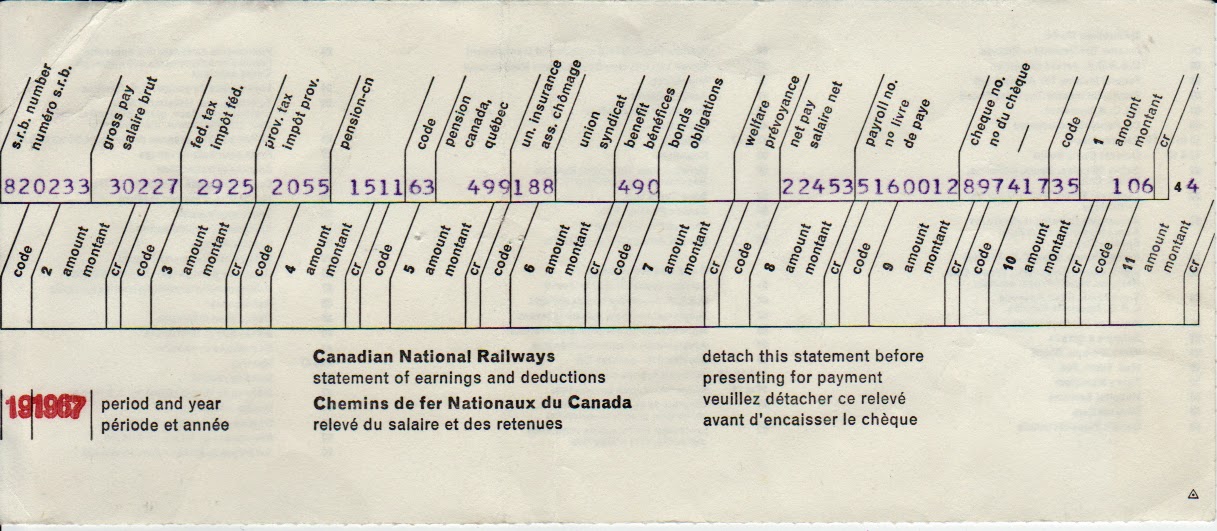
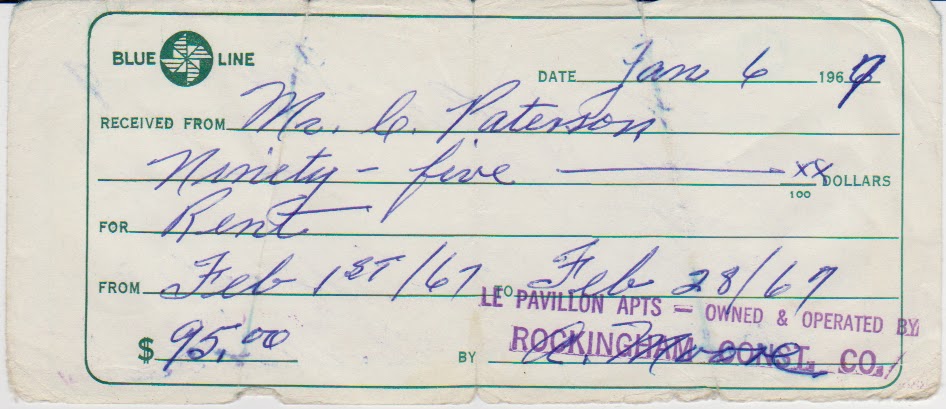
Delta Upsilon rent receipt 1966. Note party expense.
There was a group of older guys staying in the house. They all worked for a company out of Winnipeg called Daley Display (spelling) who had the contract to create the interior of The Western Canada Pavilion at Expo 67. One night, at dinner, I was asked by the owner of the company if I would be interested in working as a labourer for them. I hadn’t been doing much other than moving some guy’s car around while he was away in the cramped parking lot behind the frat house. A Plymouth Valiant with push button gears.
Would I be interested in a job? Your damn right I would! The job paid $2.52 an hour and it was a 55 hour work week, 10 hours a day Monday through Friday, and another 5 hours on Saturdays. This was almost double the pay I would make at any other job I ever held in Montreal. About 138 bucks a week. I was young and had a lot of energy and this job looked like pretty easy money to me.
In the dark early the next morning I climbed into a truck with the rest of the crew and we headed down to the new island that had been built in the middle of the St. Lawrence River. When I was a kid, I had seen the construction of the St. Lawrence Seaway so I was kind of prepared for the massiveness of the project.
At this point almost all of the earth and rocks had been brought in to create the island. Canals had been formed but there was no water in them. Most of the pavilions had been constructed and the exteriors were being finished. Landscaping and paving were still not underway.
The Expo site kind of looked like a giant ant farm. There was a lot of movement. Thousands of tradesmen turned up each day. There were cement trucks coming and going, huge cranes maneuvering materials, and earth movers redirecting the dirt. The whole deal was a pretty amazing feat. I am sure that there were lots of difficulties in coordination along the way. One day I heard through the grapevine that about 16 thousand dollar’s worth of plate glass had fallen off a scaffold at the French Pavilion.
The Western Canada Pavilion represented the 4 western Canadian provinces, Manitoba, Saskatchewan, Alberta, and British Columbia. The building was designed in the shape of a tree stump with a circular shingled roof with a hole in the middle of it. Giant Douglas fir trees brought in from B.C. poked through the roof opening. I remember seeing these huge slabs of wood that had been cut off the fir trees and I thought that they would be ideal for a coffee table. The fact that they weighed about a ton killed that idea.
Western Canada Pavillion Expo 67.
Starting time was 7:00 a.m. and my job was to clean up debris and assist the tradesmen when I was needed. The first week went by fairly smoothly. It was a bit of an adventure and the novelty hadn’t worn off. In the back of my mind I kept thinking of my big juicy paycheque.
After about 2 weeks I started to wear down a bit. 10 hour days and 5 more on Saturday were starting to take a toll on me. Like many other 19 year olds, I liked to party a bit which didn’t exactly fit in with getting up before 6 in the morning.
The Western Canada pavilion had a number of themes, all representing different industries in Western Canada. There was a fish cannery, a simulated mine shaft, a potash mine, and a variety of farm equipment used on prairie wheat farms. I believe that they also had a machine that created a mist in the center of the pavilion where the huge trees were.
One of the artisans at the pavilion was a British guy who built kinetic sculptures. I didn’t have a clue what a kinetic sculpture was before being informed. Basically it is a sculpture with moving parts. In this case, the British guy welded together a number of machine parts and one of the things he incorporated into the finished product was a chainsaw.
One day we were sitting out at the back of the pavilion by the still dry canal having lunch (a high point of the day for me) when we spotted a guy in the distance in the canal walking towards us. We wondered what he was up to. As he got closer his face appeared to be very white and we could see that he had a guitar over his shoulder. His face was white because he had pancake make-up on and the reason he was carrying a guitar was because he was Gordon Lightfoot. Pretty cool.
(I was curious to see if I could find anything on YouTube with Gordon Lightfoot at Expo 67.I found a music video called “Crossroads” that does indeed show Lightfoot at the Expo 67 construction site. Unfortunately, the video doesn’t show him in the canal before it was filled with water.)
Gordon Lightfoot.
One of the small projects I was given to do was to empty large plastic bags of potash and chop the stuff into cubes that were then lathed into the walls to give the effect of being in a potash mine. Kind of sludgy stuff but it probably was the one bit of work I did that later visitors could actually see.
By the end of the summer some fatigue was starting to overtake me (and too many Labatt 50’s the nights before) and I began to find ways to hide out a bit on the job. I never actually took a nap but I wasn’t always pulling my weight. I don’t think it took the powers that be too long to figure out that they weren’t getting their money’s worth out of me.
The summer came to an end and the crew had to find new digs what with the frat boys coming back to town. For some reason, I hadn’t made any plans to find another place to live. I might have just assumed that I would move wherever the other workers moved. I was wrong about that.
I was told, rather politely, that my services would no longer be required. Although I knew that they were wise to my less than stellar performance I didn’t see losing my job coming. I had to do some quick scrambling and ended up moving into a tourist lodge that was a lot more expensive than the frat house. Any money I had put aside started to disappear quickly.
I didn’t work for the next several months. In some ways I was kind of like today’s “street person”. I would crash wherever I could. I stayed up at the McGill residences for a bit of time and used a student I knew from the US’s number with his OK to get free meals in the cafeteria. Somebody ratted me out and the cops were called and not having anything better to do I waited for them. I spent an afternoon in a jail cell at the #10 police station before being released with the promise I would not return to the residences.
I moved on to sleeping on another friend’s floor in a frat house. He was from Falls Church, Virginia. (He went on to become a professor at Emory University in Atlanta, Georgia.) It was here that my hard hat from Expo 67 disappeared. I suspected an Egyptian guy who I spotted wearing my friend’s sleeveless sweater as an undershirt.
Expo 67 was 45 years ago and all I have left as a souvenir from working on construction there is this badge.
My construction badge from Expo 67.
 
I would love to hear from others on their experiences at Expo 67. Maybe even put them up on my blog.