Total Pageviews

Thursday, 10 July 2014

Gimme Some Of That Rock And Roll Music


If you lived in Montreal in the 1950s or are interested in that era, I highly recommend a book about the Snowden area of Montreal way back then.  A number of people submitted their thoughts and remembrances of the days when the streetcars ran and you could smell the aroma from Peggy’s Nut Shoppe on a cold winter’s day. The book is called More Memories of Snowden In The 50s. The author of the book is Bill Conrod who now lives in Ottawa. To purchase the book just e-mail Bill at jillbillc@sympatico.ca


In 1956 I was 9 years old. I may of have been quite young but I was into rock and roll from the beginning of its popularity. I saw Elvis Presley’s first TV appearances on The Ed Sullivan Show, The Dorsey Brothers Show, and The Milton Berle Show. I may have missed Elvis’s appearance on The Steve Allen Show because it was on at the same time on Sunday nights as The Ed Sullivan Show which was a staple in the house I grew up in.

https://www.youtube.com/watch?v=6QDDo1j3a7U
 
I often watched Dick Clark’s American Bandstand program after school at around 4 p.m. I had no idea at the time that the young talents Clark had on his program were lip syncing. Over a period of time some of the teenagers who danced on the program became familiar faces to me.
Radio was where the biggest access to rock and roll was but growing up in Montreal there were only certain stations that played that kind of music and only at particular times of the day, usually in the late afternoons and evenings. What totally blew me away as a kid was that there was always something new happening in rock and roll music.
Radio always made people use their imaginations. I remember hearing Freddy Cannon sing a song called Way Down Yonder In New Orleans. I pictured Freddy as some blonde haired guy from the American South only to find out later that he was an Italian guy from Massachusetts.
There are some that look at the music of the later 1950s and early 1960s as corny and simplistic. In some ways it was but so was a lot of other music we listened to in the decades that followed. There are things that may seem corny today but back in the day when we were in the moment there were thoughts a lot of us had about what we were listening to that stirred our emotions. We were too young to be cynical.
I’m pretty sure that a lot of younger people today think that teenagers in the 50s and 60s listened to nothing but rock and roll. First of all even the term “rock and roll” is a pretty loose description of a type of music. Does it include doo-whop? Does it include ballads?
1950-1956
What we were actually listening to on the radio back then was “popular music”. That might sound kind of dull but it wasn’t. It was like one continuous variety show. It didn’t really matter what area of music a tune came from as long as the song was catchy.
Starting in the 1930s there were two magazines that tracked the popularity of songs based upon record sales. One was called Billboard and the other was called The Hit Parade. From the late 30s through the mid-1950s most popular music was performed by big bands and crooners. The big names in popular music in the early 50s that catered to younger people were singers like Johnny Ray, Eddie Fisher, Perry Como, Nat King Cole, Patti Page, and Rosemary Clooney. Joining them at the top of the charts were white singing groups like The Four Lads, The Crewcuts, The Ames Brothers, and The Four Aces.
Dean Martin and Perry Como

https://www.youtube.com/watch?v=zahYUpDgfWs
To get an understanding of where popular music was for the first half of the 1950s one has to understand the times in the US. Eisenhower was the president and The Cold War with the USSR was going on. The US economy was booming. The middle class was becoming larger. There was still racial segregation in the US South. America was a conservative country at the time. Families that had experienced The Great Depression and WW2 were often satisfied with the status quo. Things were good now. They didn’t want to see the boat rocked. Often things that were considered to be different were thought to be a threat. There was an image that many middle class American families wanted to project that included patriotism, hard work, and solid morals. Years later this would be called “family values”.
Musically in the early 1950s there wasn’t any “rocking the boat” in popular music. Songs lke How Much Is That Doggy In The Window, Cross Over The Bridge, Hernando’s Hideaway, and Stranger In Paradise were hardly threats to the moral fiber of America’s young people.
The same couldn’t be said for the movies. Marlon Brando and James Dean became big stars in the early 1950s. In the 1953 movie The Wild One Brando played a rebellious motorcycle gang leader and leather motorcycle jackets became popular with a segment of America’s youth. In his short movie career Dean played a confused teenager angry at being told what to do by his parents. In real life Dean would forever be 24 years of age after dying in car crash while driving his Porshe on a California highway.
Marlon Brando
Around 1952 something was starting to percolate in music. A number of radio stations, particularly smaller ones, realized that they were going to have a really tough time of it competing with television which had just become the number one source for family entertainment. A number of smaller radio stations converted their entertainment format to include a type of music called rhythm and blues (R & B). This type of music was almost entirely played by black people. The lyrics could often be on the risqué side but because most of the radio audience was black nobody in authority was paying much attention.
Some white guys, particularly in the South, started listening to black R & B and fell in love with the music. A number of these guys had backgrounds in country music and made attempts at combining R & B and country music. Drums became an important part of this new style of music with a heavy back beat. This new music style is sometimes called Rockabilly. It wouldn’t be called rock and roll until several years later. A Rockabilly band usually consisted of a lead and rhythm guitar player, a stand-up bass player, and a drummer. Some bands added a piano player or a saxophonist.
The first rock and roll song to reach the charts was probably Bill Haley and the Comet’s Crazy Man Crazy which came out in 1953. The first really big rock and roll hit was probably Bill Haley’s cover of black R & B singer Big Joe Turner’s song Shake, Rattle and Roll in 1954. Haley’s version had the lyrics “Get out of that kitchen and rattle those pots and pans.” Turner’s version was more like he was kicking some gal out of bed to make him breakfast. Not the kind of stuff that conservative America wanted their kids to be listening to.
Bill Haley

https://www.youtube.com/watch?v=ZgdufzXvjqw

In 1955 a movie came out called Blackboard Jungle. It starred Glenn Ford as a teacher at an inner city school trying to manage some unruly students including a young Sidney Poitier. The movie also introduced the song Rock Around The Clock also done by Bill Haley and the Comets. Blackboard Jungle brought in 10 times the investment it cost to make the movie and kind of set a pattern for youthful rebelliousness and fast paced music with a heavy drum beat.
During his career Bill Haley and his Comets sold over 25 million records. He wasn’t ugly but he also wasn’t handsome. He had a kind of doughy face and “kiss Curl” hung from his forehead. Although he was only about 27 at the time he looked older and not the kind of guy teenaged girls could identify with. It wouldn’t be long before a young man who was the complete package would turn American popular music on its head.
Elvis Presley was born in Tupelo, Mississippi and grew up in Memphis, Tennessee. His family was poor and his father once spent 8 months in jail for cheque forgery. One day when Elvis was about 18 he walked into Sun Records in Memphis and made his first recording. He said he made the record for his mother who he was very close to but some others thought he wanted to impress the owner of Sun Records, Sam Phillips.
Elvis’s first public appearances happened in 1954 and he was backed by a drummer and a guitarist.. In 1955 he became a regular on the Saturday night country and western radio program Louisiana Hayride out of Shreveport Louisiana. The Louisiana Hayride was broadcast to close to 200 stations in 28 States. It might have been nervousness that made Elvis shake his legs while singing. The shaking became part of his act and it drove a lot of female teenagers wild.
By late 1955 Elvis had acquired a new manager, Colonel Tom Parker, who was Elvis’s manager for the rest of the colonel’s life. Parker bought Elvis’s contract from Sam Phillips and got Elvis signed to the RCA Records label for 40 thousand dollars. Parker was very effective at managing Elvis but he was a bit of a mystery man. His title, colonel, was an honourary one. It was questionable whether or not Parker was actually an American citizen. He was born in The Netherlands and it has been said that he jumped ship to stay in America. Parker’s background before he met Elvis was working at carnivals and he was experienced at the con and the hustle. In Elvis’s career the only other country he performed in other than the US was a few dates in Canada. This may have had something to do with Parker not having a passport.
1956
Whatever Parker was he was good at his job. He got Elvis major exposure on a number of the biggest variety TV shows at the time including The Ed Sullivan Show. Right from the start Elvis’s hip swiveling and leg shaking drove conservative American parents crazy. They looked at Elvis as a juvenile delinquent type who was going to be a bad influence on their kids. The TV cameras started filming Elvis only from the waist up.
Elvis became a sensation to millions of younger Americans. With his dark dyed black hair and sideburns he looked different. He didn’t look anything like previous teen heartthrobs like Frank Sinatra and Eddie Fisher. He was good looking, had a unique voice, and brought excitement to all his appearances. He had a kind of humbleness that girls and some parents liked.
Elvis was the right person at the right time. In 1956 he had a number of major hits including Hound Dog, Don’t Be Cruel, I Want You, I Need You, I Love You, Heartbreak Hotel, and Love Me Tender. His first movie Love Me Tender was released in November of 1956.
Elvis

https://www.youtube.com/watch?v=1SF58opo6Ps
The wild Elvis with the swinging hips fairly quickly became a cleaned up Elvis. Tom Parker realized that in order to capture the hearts and minds of conservative America Elvis would have to become more clean cut. It wasn’t that long before the sideburns disappeared. In the movies Elvis always played the good guy who was honest and trustworthy. The ladies chased him more than he did them. There was never an Elvis movie plot that included Elvis getting laid.
Elvis didn’t put rock and roll on the map all by himself. He had a lot of help. 3 black guys, Fats Domino, Little Richard, and Chuck Berry had a lot to do with the success of this new music. A year or so after Elvis found fame Jerry Lee Lewis would put an exclamation mark on rock and roll.
Out of the 4 of these other guys Fats Domino was by far the tamest. His hits in 1956 alone included My Blue Heaven, Blueberry Hill, and Blue Monday. Fats Domino sang and played a kind of rolling style on his piano. His background in music was R & B and he started playing piano in the late 1940s.
Fats Domino

https://www.youtube.com/watch?v=xbfMlk1PwGU
If Fats Domino was non-threatening, the same couldn’t be said for Chuck Berry. He scared the living shit out of conservative America, For starters he looked a lot older than the teenagers he played in front of and he had a pencil thin mustache. Berry’s signature move on stage was bending his knees and strutting across the stage while playing his guitar. It wouldn’t be a big stretch to say Berry was sexually suggestive. He waved his guitar around like it was his penis. You knew that the women he got involved with personally or sang about were a lot looser than the typical teenager of the time.. Chuck Berry had a whole string of hits that became rock and roll standards including Roll Over Beethoven, Rock And Roll Music, Johnny B. Goode, Sweet Little Sixteen, and Maybelline. In the early 60s he had a few more hits including You Never Can Tell and No Particular Place To Go. Berry wrote a lot of the songs he sung.
Chuck Berry

https://www.youtube.com/watch?v=LgQJHyLLTHU
 
Richard Penniman was Little Richard’s real name. His background in music before getting into rock and roll was church gospel music. Little Richard transferred the wild frenzy and exuberance he had witnessed in gospel churches to rock and roll. He often screamed the lyrics to his songs in a high pitched voice. Elvis was pretty tame next to Little Richard’s flamboyancy. Little Richard was the first rock and roller to challenge the boundaries of male sexuality. He may have picked this up from a garish wrestler at the time, Gorgeous George. Richard wore eye makeup and sometimes had a feather boa around his neck. Among his hits in the 1950s were Tutti Fruiti, Lucille, Jenny, Jenny, and Keep A-Knockin’.
Little Richard

https://www.youtube.com/watch?v=z3-OaNevkfg
1956 was also the year that Pat Boone had his first hit songs. Some people may not know that in 1956, and for a few years after, Pat Boone was just about as popular as Elvis was. He was what a lot of American conservative parents wanted their kids to have as a role model. He was clean cut, photogenic, and had a great voice. He got married when he was 18 to the daughter of country music legend Red Foley. Being married didn’t seem to affect his popularity.
Pat Boone

https://www.youtube.com/watch?v=IjP5FHGOnHk
Pat Boone and his management were notorious for taking a black R & B tune and homogenizing it. Among the songs originally recorded by black artists that Pat Boone covered were Ain’t That A Shame by Fats Domino, Tutti Fruiti by Little Richard, Don’t Forbid Me by Charles Singleton, and I Almost Lost My Mind by Ivory Joe Hunter. Other hits Boone had in the middle to late 50s were Bernadine, April Love, Friendly Persuasion, and Love Letters In The Sand.
Like Elvis, Pat Boone starting making movies in 1956. For a while he had his own TV show. For a brief period the white bucks shoes Boone wore were a bit of a craze with some American teens. Many years later Pat Boone’s Christian faith became more evident and as he got older he turned into a right wing crackpot.
A black singing group that consisted of 4 guys and a girl and called The Platters had 3 hits in 1956, My Prayer, The Great Pretender, and Magic Touch. The Platters sold more records than anyone else in the 1950s other than Elvis and Pat Boone. Two cross over hits from country music that year were Tennessee Ernie Ford’s Sixteen Tons and Johnny Cash’s I Walk The Line. Carl Perkins had his one big hit with Blue Suede Shoes.
The Platters

https://www.youtube.com/watch?v=FyM8NVl4yBY
 
Gene Vincent and The Blue Caps had their only major hit in 1956, Be-Bop-A-Lula. Vincent’s music was of the Rockabilly style. He had trouble in coming up with another hit and spent a number of years performing in the UK. He died at the young age of 35 due to health problems brought on by alcoholism.
Gene Vincent

https://www.youtube.com/watch?v=vDU9FP5_B2M
One of the most popular black singing groups in 56 was Frankie Lymon and the Teenagers. Lymon’s song, Why Do Fools Fall In Love, would symbolize early rock and roll as much as any other song.
1957
1957 was as big a year in rock and roll as 1956 was. There was a lot of new talent that had their first hits in 1957. Elvis picked up where he left off in 1956 and had a number of more hits with songs like Jailhouse Rock, All Shook Up and Loving You.
It seemed like there was something in the water in the US South.
One of these Southerners was a guy named Jerry Lee Lewis. He was pure high energy and could really put on a show. He had unruly blonde hair that flew about as he worked himself into a frenzie while playing his piano. Sometimes he would get up on top of his piano. He even played his piano with his feet. Jerry Lee Lewis pumped out hit after hit starting in 1957. His songs included Great Balls Of Fire, A Whole Lot A Shakin Going On, Breathless, and High School Confidential. You might say the Jerry Lee was the first white bad ass in rock and roll.
Jerry Lee Lewis

https://www.youtube.com/watch?v=8yRdDnrB5kM
 
In May of 1957 Buddy Holly and the Crickets had their first hit with a song called That’ll Be The Day. Holly was from Lubbock, Texas and looked like a bit of a geek with his black rimmed thick glasses. The group spent a week in 1957 playing the Apollo Theatre in New York City which was like a shrine for black entertainers. Buddy Holly’s musical career was short, lasting only about two years, but he introduced a number of rock and roll standards in that time including Rave On, Peggy Sue, Not Fade Away, and True Love Ways.
Buddy Holly and the Crickets

https://www.youtube.com/watch?v=WvJXCNwzBq4
The Everly Brothers, Don and Phil, moved around a lot when they were kids and lived in Kentucky and Tennessee. They looked a lot alike although they were 2 years apart in age. Their Dad Ike was a country singer and had his own show on radio in the 1940s. Don and Phil grew up singing country music with their parents. Their first big hit was in 1957 with Bye Bye Love. They went on to have a long career in rock and roll. Some of their bigger hits were All I have To Do Is Dream, Cathy’s Clown, I Kissed You, Bird Dog, Wake Up Little Suzie, and Walk Right Back.
The Everly Brothers

https://www.youtube.com/watch?v=4X7b2E_Jq-k
In 1957 many Americans would tune in a TV program called Ozzie and Harriet once a week. It was kind of a light family sitcom. Nobody ever seemed to know what the dad Ozzie did for a living but they knew he liked ice cream. The younger of the two sons on the program was Ricky Nelson. Both of his parents had been in the music business. Ozzie had led a big band  in the 1930s and 40s and Harriet had been a big band singer. Ricky started singing to impress a girl at his high school. Soon after he was singing on the TV show and he got a lot of national exposure. He was one good looking dude with a pleasant singing voice. Teenaged girls couldn’t get enough of him. His first hit in 1957 was a song called A Teenager’s Romance which was followed by Be-Bop Baby. His biggest hit was in 1958 with Poor Little Fool.
Ricky Nelson

https://www.youtube.com/watch?v=zLkCWT2neuI
A couple of male black singers were starting to make a name for themselves in 1957. Soul Music was still a few years away but Sam Cooke gave a hint of what was to come with his song You Send Me. Back in 1957 if a vote was taken among American teenagers and they were asked whose music they would prefer playing in the background while they were making out on the couch, Johnny Mathis’s name would likely come up. Almost all his songs were slow ones. He had two hits in 1957 with Chances Are and It’s Not For Me To Say.
Another black guy who started ripping it up in 57 was Jackie Wilson with his song Reete Petite. The song Reete Petite was partly written by future Motown founder Berry Gordy. Jackie Wilson was like a 50s version of James Brown. Wilson was known for his high energy and his moves on stage which included collapsing to his knees. Some of his biggest hits were Your Love Keeps Lifting Me Higher And Higher, Baby Workout, Lonely Tear Drops and That Is Why. Jackie Wilson’s cousin was Levi Stubbs who later became the lead singer for The Four Tops. Wilson had a heart attack on stage while singing when he was 40 and died 9 years later.
Jackie Wilson

https://www.youtube.com/watch?v=j1nZ-u41H9s
 
One of the biggest female singing stars of the late 1950s was Connie Francis. Her big hit in 1957 was Whose Sorry Now. She would have a number of hits in the ensuing years including Stupid Cupid, Lipstick On Your Collar, and Where The Boys are. Connie Francis briefly dated Bobby Darin in the late 50s. Her dad ran Darin off at gunpoint and she has said not marrying Darin was the biggest regret of her life. In 1974 Connie Francis was raped after performing at The Westbury Music Fair in New York. In 1981 her brother was shot and killed by a mafia hit man. This woman had more than her fair share of bad luck in life.
Connie Francis

https://www.youtube.com/watch?v=5Ws60MDF7OY
Two of the biggest country music crossover hits for the year were Bobby Helms’s My Special and Sonny James’s Young Love. A young Canadian teenager from Ottawa, Paul Anka, had his first hit with a song called Diana. Other big tunes in 57 include The Del-Vikings Come Go With Me, The Rays’ Silhouettes, The Diamonds’ Little Darlin, Guy Mitchell’s Singing The Blues, and Buddy Knox’s Party Doll.
1958
The most popular tune in America in 1958 was a song called Volare and it wasn’t rock and roll. Originally the song came out in Italian and was sung by Domenico Modugno. He was pretty well never seen or heard from again in America after his one big hit. Volare was covered later on by Bobby Rydell, Dean Martin and many years later still by The Gypsy Kings.
Two novelty songs that got a lot of air play in 1958 were Shep Wooley’s Purple People Eater and David Seville’s My Friend The Witch Doctor. Seville’s real claim to fame was inventing the cartoon characters The Chipmunks and doing their voices.
Danny and the Juniors had a hit in 58 with At The Hop. Do-whop music which was all about 3 and 4 part harmony was becoming more and more popular with teenage America.
Bobby Darin had his first big hit with Splish Splash in 58. Over his career Darin would have hit songs in a number of different forms of music. 18 Yellow Roses was country. If I Were A Carpenter was folk. Dream Lover was rock and roll and Mack The Knife and Beyond The Sea were crooning songs backed up by big bands. Bobby Darin was 22 when he discovered that who he thought was his sister was actually his mother. He was sickly a good part of his life and died at the young age of 37 after open heart surgery.
Bobby Darin

https://www.youtube.com/watch?v=QzkECdHu1dQ
In 1958 J.P. Richardson (The Big Bopper) had his lone big hit with Chantilly. A young guy from Philadelphia, Frankie Avalon, found himself on the charts for the first time with his songs Dede Dinah and I’ll Wait For You. Duane Eddy had one of the first rock and roll instrumental hits with Rebel Rouser.
Sometimes forgotten in the history of rock and roll was a young Canadian guy from Windsor, Ontario named Jack Scott (originally Giovanni Scafone Jr.). He lived in Canada until was 10 when the family moved across the river to Detroit. He had a deep singing voice with a bit of a country twang. In 1958 he had a double sided hit with My True Love and Leroy.
Jack Scott

https://www.youtube.com/watch?v=iksyruTrYZc
By 1958 black singers and black singing groups were all over the charts. They may have had to enter through the side door at the hotel they were staying at and not allowed to mix with their audience when travelling in the US South but when it came to having their songs played on the radio, race didn’t matter as long as the tune was catchy. Little Anthony and the Imperials had a hit with Tears On My Pillow and The Monotones had a hit with Book Of Love.
The first rock instrumental to reach #1 on the pop charts was The Champs tune Tequila. Glen Campbell and folkies Seals and Crofts later played with The Champs.
Once in a while a folk song would make it onto the charts in the 1950s. In 1958 the Kingston Trio had a hit with a song called Tom Dooley. 4 or 5 years later folk music would become very popular with a lot of college types in the US.
In 1958 a 13 year old girl introduced a song that would become a Christmas standard. Her name was Brenda Lee and the song was Rockin Around The Christmas Tree. She had a very distinctive voice and often seemed to be pleading when singing. Among her hits over the years were I’m Sorry, As Usual, All Alone Am I, and Break It To Me Gently.
Another often forgotten name from early rock and roll is Eddie Cochran. In 1958 he had a big hit with Summertime Blues. He died in a car accident in the UK in 1960 at the age of 21. He may have been the first of a number of rock and rollers to die young.
Eddie Cochran

https://www.youtube.com/watch?v=HWbXCz9UZYo
Here’s a list of some of the other big songs on the Hit Parade in 1958. It’s All In The Game by Tommy Edwards, Little Star by The Elegants, Yakety Yak by The Coasters, Rockin’ Robin by Bobby Day, Short Shorts by The Royal Teens, When by The Kalin Twins, Kisses Sweeter Than Wine by Jimmy Rogers, 26 Miles by The Four Preps, Born Too Late by The Poni Tails, and Chanson D’Amour by Art and Dottie Todd.
Among the country crossover hits of 1958 were Don Gibson’s Oh Lonesome Me, Marty Robbin’s The Story Of My Life, and Conway Twitty’s It’s Only Make Believe.
Conway Twitty

https://www.youtube.com/watch?v=LJefPaBsSug
1959
1959 was a landmark year in rock and roll. On February 3rd a plane carrying Buddy Holly, The Big Bopper, a young Mexican American singer named Richie Valens, and a 21 year old pilot,  Roger Peterson, crashed in a corn field near Clear Lake, Iowa. It was a small plane and all four passengers died. That day would later be immortalized in Don MacLean’s song American Pie which came out in 1971. “The day the music died.”
Buddy Holly, The Big Bopper, Dion and the Belmonts, and Ritchie Valens were in the middle of a tour (called The Winter Dance Party) of one night stands across the mid-west States. Buddy Holly was the veteran of the group. About a year earlier he had parted company with his manager and his band The Crickets and replaced The Crickets with some other musicians including Waylon Jennings. The Big Bopper was the oldest of those that died. He was 28 and had one big hit, Chantilly Lace. Dion the Belmonts were a doo whop group who also only had one big hit at the time, I Wonder Why. Richie Valens had 3 big hits before he died, Come On, Let’s go and the double sided record hits La Bamba and Donna.
Dion and the Belmonts

https://www.youtube.com/watch?v=zWRl-l_-jVg
 
Ritchie Valens

https://www.youtube.com/watch?v=-ziSLGVQOSg
The Big Bopper

https://www.youtube.com/watch?v=jNrpAgTXiC4
 
Buddy Holly

https://www.youtube.com/watch?v=ku5UeUT7yIQ
The group had been traveling by bus in the middle of the winter. The heater on the bus packed it in and one of the back-up musicians got frostbite in his toes. The bus was replaced by a school bus but by then a number of the crew had come down with the flu including The Big Bopper. It was Buddy Holly who decided he wanted to fly ahead of the tour, partially because he wanted to get some laundry done. Dion took a pass on the plane ride because he thought the $35.00 fare was too much money. Waylon Jennings gave up his seat to the sick with the flu Big Bopper. Ritchie Valens won a coin toss with another musician to secure his seat.
After the crash and the death of the three young rock and rollers the tour resumed with Bobby Vee taking the place of Buddy Holly. That the tour continued at all is a sad comment on the business behind rock and roll.  2 months after the crash, in May of 1959, Dion and the Belmonts had one of their biggest hits with A Teenager In Love.
From the beginning of rock and roll touring smaller cities was part of the deal of being a rock and roll star. The promoters always got most of the money. Las Vegas was where the money was for big name entertainers but promoters there weren’t much interested in young rock and roll stars because teenagers were too young to drink or gamble. Elvis was about the only rock and roll star who could fill big stadiums in big cities but Tom Parker didn’t want Elvis to be over exposed.
Rock and Roll didn’t die in 1959 but for the most part it had been tamed. Elvis was in the military from 1958 to 1960. His image had been cleaned up for some time so that he was more suitable for “white bread” audiences. Jerry Lee Lewis was shunned by both the American public and promoters when it was discovered that he had married his 13 year old cousin once removed. Little Richard rediscovered religion and became an evangelical. In December of 1959 Chuck Berry was arrested under The Mann Act for having sexual relations with a 14 year old. After a number of trials and appeals he ended up spending 1-1/2 years in prison.
A lot of the raw grittiness of rock and roll disappeared. Not totally but to a large extent. Rock and roll was becoming more and more manufactured by the people behind the scenes. Just find a good looking guy and teach him how to sing and watch the money come rolling in was one way of doing it. This is exactly what happened to a singer called Fabian (Fabian Forte). He couldn’t carry a tune to save his life and still he became a big star. So what if he couldn’t sing they probably thought, the movies were always looking for handsome young guys. When Fabian was drafted into the army he got a deferment when he claimed that being around a lot of men might stir up his homosexual tendencies.
New rock and roll stars were starting to come more from the north eastern area of the US, from places like Philadelphia and New York. People like Bobby Rydell and and Frankie Avalon. Up until 1959 most big names in rock and roll had come from the US South.
Bobby Rydell
Frankie Avalon
The biggest song on the Hit Parade in 1959 was Johnny Horton’s The Battle Of New Orleans. He later had other hits with Sink The Bismark and North To Alaska. Horton died in a car crash on a highway bridge in Texas in 1960.
A trio from Washington State that consisted of 2 girls and a guy and called The Driftwoods had 2 big hits in 1959, Come Softly To Me and Mr. Blue. Santo and Johnny had a big hit with an instrumental called Sleepwalk. Black singer Lloyd Price had 2 hits that year with Stagger Lee and Personality. Ray Charles had his first hit with What I Say.
Black singing groups had a lot of hit tunes in 1959 including The Coasters’ Poison Ivy and Along Came Jones and The Flamingo’s I Only Have Eyes For You.
Other big songs from 1959 include The Skyliners’s Since I Don't Have You, The Bell Notes’s I’ve Had It, Frankie Avalon’s Venus, Bobby Darin’s Dream Lover, Ritchie Valen’s Donna, The Crests’s 16 Candles, and Jerry Wallace’s Primrose Lane.
Reg Owen’s Manhattan Spiritual and Dave “Baby” Cortez’s Happy Organ were two of the biggest instrumental hits of the year.
Once again country based tunes also were on the charts including The Brown’s The Three Bells, Stonewall Jackson’s Waterloo, Billy Grammer’s Gotta Travel On, and Jerry Wallace’s Primrose Lane.
1960
“Payola” was a word that was created around 1960 to describe the receiving of cash from record promoters that was given to disc jockeys to play certain records. The theory the record companies had was that teenagers weren’t that bright and if they heard a record on the radio enough they would go out and buy it whether or not they really liked the song.
The US congress started to investigate Payola in 1959 and in 1960 they had hearings. A number of people were called as witnesses including Alan Freed, the disk jockey who coined the term “rock and roll " and TV’s Dick Clark who hosted the afternoon teenage music show American Bandstand. Freed has been credited for introducing black R &B music to white America.
When all was said and done Alan Freed’s career as an influential disc jockey was over. Taking money for playing certain records became illegal. Alan Freed had been involved with rock and roll from the very beginning. His radio show was one of the first to promote rock and roll music and he had a huge following. His radio name was “Moondog”. Starting in 1956 Freed produced a number of rock and roll movies. He also promoted a number of rock & roll tours in the US.
Alan Freed
Freed had a short temper and could get in anyone’s face who criticized rock and roll. He was the prime target in the US congressional heariings. Squeaky clean Dick Clark, on the other hand, got off Scott free. At one time Dick Clark had investments in something like 33 record labels. One of those record labels was called Jamie Records that made guitarist Duane Eddy famous. Clark made over 31 thousand dollars on his initial investment of 125 dollars in Jamie Reords.
Over a period of time Clark had an interest in around 150 pop songs. He often received royalties for being one of the song’s writers when he wasn’t. Today there are some old videos around on YouTube showing Clark on American Bandstand with teenagers back in the 50s and asking them to rate some new songs that were just being introduced. It is more than obvious that a number of the songs the teenagers were asked to rate were absolutely terrible.
Dick Clark certainly knew all of the greats in rock and roll in their heydays. Never the less he really wasn’t anything more than a slick huckster. After he died several years ago it seems that the baton has been passed to Ryan Seacrest.
Dick Clark
1960 was the year that Chubby Checker introduced The Twist. It was a pretty big hit but the Twist sensation didn’t really take off until about a year later when Chubby recorded Lets Twist Again.
Chubby Checker

https://www.youtube.com/watch?v=XmR00cErBdw
1960 was also the year that a man with one of the most beautiful voices in rock and roll had his first big hit. His name was Roy Orbison and the song was Only The Lonely. Orbison wasn’t much to look at but he could sing a song like nobody else. He also wrote his own songs. Among the hits he had in his career were Crying, In Dreams, Up Town, Running Scared, Oh Pretty Woman, Dream Baby, Blue Bayou, It’s Over, Love Hurts, and Mean Women Blues. The man was prolific. Orbison had bad eyesight all of life and wore sunglasses on stage. He also had a lot of tragedy in his life, losing his first wife in a motorcycle accident and two of his kids who died in a house fire when he was out on tour. In the late 1980s Orbison became part of The Travelling Willburys along with George Harrison, Tom Petty, Bob Dylan and Jeff Lynne from ELO. Roy Orbison died of a heart attack in 1988 at the age of 52.
Roy Orbison

https://www.youtube.com/watch?v=DPrKUW_NT1g
Among the songs that crossed over from country music to the Hit Parade were Jim Reeve’s He’ll Have To Go, Johnny Preston’s Running Bear, Hank Locklin’s Please Help Me I’m Falling, Johnny Burnette’s Dreamin’, and Bob Luman’s Lets Think About Living. Most songs back then were a little over 2 minutes. Marty Robbin’s El Paso was just over 4 minutes long.
Jimmy Jones sung the first version of Handy Man. It would later become a big hit for Del Shannon. The Ventures had an instrumental hit with Walk Don’t Run and updated the tune and reintroduced the song as few years later as Walk Don’t Run 64.
Other big songs in 64’ were Maurice Williams’s Stay, Freddy Cannon’s Way Down Yonder In New Orleans, The Hollywood Argyles-s Alley Oop, and Bobby Vee’s Devil Or Angel.
Elvis was out of the army and his big song in 1960 was It’s Now Or Never.
1961-1964
Rock and roll was evolving. Singers were always looking for new songs that were catchy. Some of the best songwriters worked out of The Brill Building in New York. A song writer and record producer named Phil Spector was writing or co-writing a number of hit tunes including  Ben E. King’s Spanish Harlem and the first version of Twist And Shout. Spector played guitar on The Drifters’s On Broadway. Later on he would create “the wall of sound”.
In 1961 black girl singing groups became quite popular. The Shirelles had 3 big hits that year with Dedicated To The One I love, Will You Love Me Tomorrow, and Mama Said. Ben. E. King had a big hit with Stand By Me. Ray Charles sang Hit The Road Jack. Gary US Bonds recorded a song called A Quarter To Three and it sounded like a party was going on.
The Shirelles

https://www.youtube.com/watch?v=3irmBv8h4Tw
The Twist and Chubby Checker were back in 61’. This time around the Twist swept America. Adults learned how to do the dance and they could be seen everywhere from country clubs to nightclubs moving their legs around. Former US president Eisenhower condemned the Twist as a sign of the moral decay happening in America. Joey Dee and the Starlighters had a hit with The Peppermint Twist.
It wasn’t uncommon for singers and groups to dig out old songs from the 1930s and forties, speed up the tempo, and add a few gimmicks to the tune. One of those songs was The Marcels’s Blue Moon which was written by Rogers and Hart in 1934.
In 1962 The Four Seasons had their first hit with a song called Sherry. Folk music became very popular. For a while there was a TV program that was broadcasted from various college campuses called Hootenanny.  Peter, Paul, and Mary had a hit with If I had A Hammer. Trini Lopez too. The Brothers Four sang Where Have All The Flowers Gone. Dee Dee Sharp did Mash Potato Time and Little Eva did The Loco-motion.
Frankie Valli and the Four Seasons

https://www.youtube.com/watch?v=3pWBnodrR1M
Other big songs of 1962 include Bryan Hyland’s Sealed With A Kiss, Bruce Channel’s Hey Baby, Bobby Vinton’s Roses are Red, Gene Chandler’s Duke Of Earl, Neil Sedaka’s Breaking Up Is Hard To Do, Chris Montez’s Let’s Dance, Mary Wells’s You Beat Me To The Punch, and Gene Pitney’s A Town Without Pity.
In 1962 a gal named Toni Fisher had a big hit with a song called West Of The Wall. The song was about two lovers who were divided because of the Berlin Wall.
1962 would also see the first appearance of a west coast group called The Beach Boys. Their hit in 62 was Surfin’ Safari.
A lot of the music in 1963 was about surfing on the west coast and singing groups from northern places in the US like Detroit, Philadelphia, and New Jersey.
Jan and Dean had a hit with Surf City. 2 surfing instrumental tunes, The Chantays’s Pipeline and The Safaris’s Wipe Out made it to the top of the charts. The Beach Boys had a whole string of hits in 1963 including Surfer Girl, Catch A Wave, In My Room, Surfin’ USA, Little Deuce Coupe, Shut Down, Things We Did Last Summer, and Little Surfer Girl. Only one of The Beach Boys knew how to surf.
The Beach Boys

https://www.youtube.com/watch?v=6JuRhsB322k
If girl singers and girl singing groups were kind of left out of the earlier years of rock and roll they were certainly making up for lost time in 1963. They were all over the charts with songs like Easier Said Than Done by the Essex, Hello Stranger by Barbara Lewis, Be My Baby by The Ronettes, The Doo Ron Ron by The Crystals, One Fine Day by the Chiffons, and Just One look by Doris Troy.
The Ronettes

https://www.youtube.com/watch?v=jrVbawRPO7I
The Miracles with Smokey Robinson had a hit with You Really Got A hold On Me and Marvin Gaye had a hit with Pride And Joy. These were the early years of the Motown sound.
Jimmy Soul had a great party song in 63, If You Want To Be Happy. Some disc jockeys wouldn’t play the song because the lyrics included a reference to ugly women. The original Jersey Boys The Four Seasons had hits in 63 with Walk Like A Man and Candy Girl.
Towards the end of 1963, on November 23 in Dallas, Texas President John Kennedy was shot and killed. Time kind of stood still for a few months.
In February of 1964 The Beatles turned up on The Ed Sullivan Show. Not much later The Dave Clark Five made their first visit to America. It was the beginning of The British Invasion. Popular music would change forever. What was considered rock and roll would still be around but it wouldn’t be quite the same. The old tunes became part of nostalgia and although a lot of the originators of rock and roll had been ripped off by agents and record companies many of the them could still make a buck many years later by performing their old tunes. Every once in a while PBS has them on TV. It won’t be that long before all of the entertainers from early rock won’t be around anymore.
The Beatles
It was a blast while it lasted!
 
Some Of My Personal Picks
Best rock and roll song ever. Don’t Be Cruel by Elvis Presley.
Best rock and roll instrumental. Last Night by The Mar-Keys.

https://www.youtube.com/watch?v=m7Rq1SL1goc
Most underated female singer. Timi Yuro and her song I’m So Hurt.
Most prolific rock and roll songwriter. Roy Orbison.
Best white guy hand moves on stage. Len Barry of the Dovells.
Wildest white guy moves including a somersault off of the stage. Roy Head.

https://www.youtube.com/watch?v=2BLQgQNuN-M

Best falsetto voices. Frankie Valli, Lou Christie, Del Shannon.

https://www.youtube.com/watch?v=w05w1XbZTG8
Happiest rock and roller on stage. Fats Domino.
Best foreign song to make The Hit Parade. Sukiyaki by Kyu Sakimoto.
Best Rockabilly tune. Heartbeat by Buddy Holly.
Best imagery in a song. On Broadway by The Drifters.
Best black male singing voice. Sam Cooke singing You Send Me.
Most under rated black female singer. Barbara Lewis. Hello Stranger and Baby I’m Yours.

https://www.youtube.com/watch?v=XSa0EH0LiGk
Closest to sounding like Elvis. Terry Stafford singing Suspicion.

https://www.youtube.com/watch?v=vKI9Mcwaf14
 
 
Thanks for coming out.Goodnight and drive safely and don’t forget if you have a bit extra cash Radio Free Europe can use it.


Tuesday, 3 June 2014

Benndorf-Verster


I think it was February of 1977 that I first walked through the door of a Vancouver business equipment supplier called Benndorf-Verster Ltd. (BV). I would spend the best part of the next 7 years working for the company as a sales representative. A lot of things happened in those 7 years. I saw a small company grow into a large one. I saw a lot of people come and go and sometimes it seemed like a blur. I went from barely getting by to making very decent money. And oh yeah….I got married to one of my co-workers.
The name Benndorf-Verster was only around for about 20 years before it morphed into something else. Years later the name was resurrected. If you lived in the Vancouver area in the 80s and 90s you may have seen their TV ads. Sometime around 1976 Verster Business Machines bought out Benndorf Office Equipment.  12 years later, In 1988, the company was acquired by an American corporation called Alco Standard and in 1996 the name of the company was changed to Ikon Office Solutions.
How I ever came to be a salesman at BV was a fluke, or maybe it was fate. I took a bit of a circuitous route to 1910 Quebec Street in Vancouver where BV was then located. In the fall of 1975 I was working for an industrial equipment rental company in Victoria as a sales rep.  One dark early November morning we were headed out to the Pat Bay Highway to catch a ferry to Vancouver where we were going to take part in a trade show.
The van I was driving was loaded with equipment. We came around a bend and I hit some black ice. We were headed towards a big tree. I tried to steer the vehicle away but one of the tires hit the curb and the van rolled over onto its roof. The other guy with me and I were not injured. He crawled out the front window and I got out of the driver’s side door. We stood there and looked at the vehicle. The tires were still turning and the radio was still on. It seemed surreal. I was toast as far as my job was concerned. Funny how that works?
In January of 1976 I decided to set off for Kamloops, BC to find work in a pulp mill. I had worked in a mill before and it seemed like a good idea at the time to save up some money and start over again in Calgary which was booming at the time. I was hired by Weyerhaueser and spent about 6 months at their mill before taking off for Calgary. My plan was to find an apartment and start looking for a sales position. There was one problem. There was a dire shortage of apartments available in Calgary and what there was were controlled by a middleman company called Rentex that required a potential renter to pay them a fee with no guarantees. I spent about a month living in a motel and was going through my savings fast. Finally I said to hell with it. I didn’t really care for Calgary all that much. I got in my car and headed for Vancouver.
I found a 1 bedroom apartment in an older apartment building on West 2nd Avenue in North Vancouver. It actually had a bit of a view of Burrard Inlet and downtown Vancouver across the water. My next door neighbor was a drunk who berated his wife and son at all hours of the day. He quieted down a bit after I knocked on his door and offered to kick the crap out of him if he kept up the noise. It was in this apartment where I watched the Rich Man, Poor Man TV series only to miss the final episode when the power went out. I also remember once almost setting the place on fire. I had used a tea towel to take something out of the oven and had gone back to watching TV in the living room. Suddenly I noticed a big flame being reflected in one of the windows. It turned out that the tea towel had caught fire and I had placed it on a metal rack attached to a utility closet. I later covered up the burn hole with some MacTac and nobody was the wiser.
The only sales job I could find at the time was one on commission selling home alarm systems for a North Vancouver company called Knill’s Alarms. I believe they were later acquired by ADT. I only hung around at this job for about 3 weeks and never made any money. One day I went on a sales call with the sales manager to a mansion in the toney district of Shaughnessy. We both sat at the end of a long dining room table while the other guy gave his sales pitch to an elderly lady. I was transfixed on her as she ate some old cheese and cut away the rancid parts. We should have been selling her a spot in a retirement home.
Knill’s Alarms was run by Bob Knill and his son John. They owned several other businesses including a lawn business, a tree pruning business, and a fuel oil business. I think they gave up on the fuel business when their tanker truck lost its brakes on a big hill. John was also a songwriter and had his own studio. I think he wrote advertising jingles. Years later I read in the newspaper that John and his wife had died in a tsunami that hit Thailand the day after Christmas in 2004.
In order to keep some money coming in I started working for a temporary agency doing manual labour. Mostly I was unloading railway boxcars of stuff like hardware and bags of sulphur. Sulphur and sweat don’t mix well and 100 pound bags of sulphur are freaking heavy.
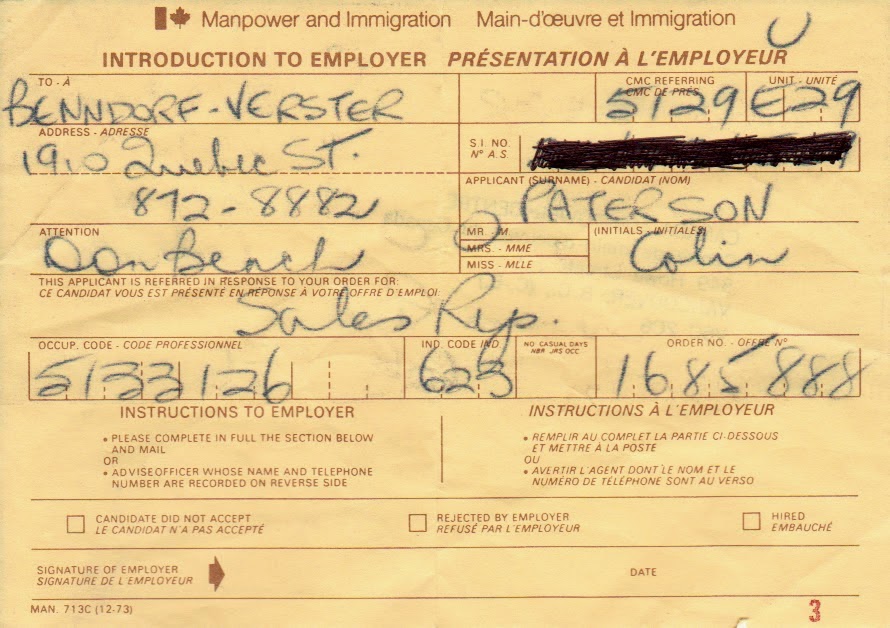
Christmas and New Year’s Eve rolled around and I wasn’t having much fun at the back breaking work I was doing. One day in January or it may have been February, I was down at Canada Manpower (I don’t know what they call it today.) and I spotted a job listing for a sales rep at a company called Benndorf-Verster. Altogether I had 3 interviews with 3 different people. I must have said something right because a few days later I got a call saying I was hired.
 
I was going to be selling typewriters, calculators, and dictation equipment and my immediate boss would be a German guy named Rudy Hintsche. The basic pay was something like $750.00 dollars a month and a $150.00 car allowance. It wasn’t great money but if I wasn’t reckless it would pay the bills.
When I started at BV there were about 30-35 employees. About half were sales reps. There was 2 sales teams, one which sold what I did, and the other team which was mostly made up of older guys who marketed Canon photocopiers, a product line that BV had acquired the exclusive rights to in Vancouver about a year earlier. One of the younger copier salesmen was a Scottish guy named Jimmy Orr. Jimmy later started a business by renting videos through newspaper ads and then opened a video store that had rats on the premises. He got into the home entertainment business and his company, Audio Video Unlimited, expanded to a few dozen stores. One of the older copier salesmen had a very pretty wife and made his calls in a camper truck. I’m not sure if they lived in the truck full time or not.
The office back then was located at the corner of West 3rd Avenue and Quebec Street about 10 minutes away from downtown Vancouver. We had the ground floor of a fairly new 3 story office building. There were 5 small offices at the front of the building that were occupied by the president, the vice president, an East Indian accountant named Amin who was from Uganda, and the two sales managers. All of these offices had glass windows in the front and back. The sales managers looked out at a large room where there were about 16 sales rep’s desks and later about 24 desks.
The service department was run by a guy named Al Reilly and it was located in the back of the building. Al didn’t suffer fools gladly you might say. In front of the service department there was the photocopier showroom where sales meetings occurred at least once a week. Next to the showroom was where a few gals worked in accounting. One of them didn’t wear a bra (remember those days?) and a couple of guys got the bright idea of turning up the air conditioning every now and then.
The front desk and reception area was run by a very efficient lady named Penny who spent many years at BV. She was also responsible for typing quotations and taking incoming phone calls.
It took me a while to warm up to my boss Rudy. He seemed a bit severe in his manner and the German accent threw me off a bit. Rudy was old school. He insisted that we learn a script that we were to use when demonstrating a typewriter. “Miss Jones, a typewriter must be flexible enough to….” The script also had areas where we were supposed to get acknowledgements. “Isn’t that right Mrs. Jones?” We learned the script to keep in Rudy’s good graces but I don’t believe anyone ever used it.
As time went on I got to know Rudy better I would sometimes play chess with him at lunchtime. I think I even beat him once. Rudy turned out to be harmless. Once in a while he would offer me unasked for fatherly advice. He thought I might have been going out on a limb when I got a better apartment and a newer used car.
We marketed Olympia brand typewriters and calculators. Olympia was a German owned company who had their products manufactured in Mexico. Just that the products were German seemed to have Rudy’s loyalty. The calculators were OK but the typewriters sucked big time. Every secretary in Vancouver at the time wanted nothing else but an IBM Selectric typewriter with the exchangeable ball element that allowed for type fonts to be changed easily. The Olympia typewriter was noisy, had a moving carriage and flashing keys, and you couldn’t change the font types. We couldn’t even convince Germans to buy an Olympia typewriter.
Within about 6 months of my joining the company almost all of the reps on my team were gone. Some quit and some were fired. Over the next several years I got quite used to seeing people come and go. It was like musical chairs. I thought of quitting myself but was talked out of it a few times. On some days I would spend an hour or two watching a case at the downtown courthouse. It wasn’t as if I was afraid of making cold calls I just wasn’t fussy about having hardly anything to sell. I’m not quite sure how but I managed to survive in this environment for about 2 years.
I got to know the vice president Al Hausch a bit. He brought me along to some early morning Toastmasters meetings that bored me to tears. Every now and then he would invite me into his office at the end of the day for a chat. Al kind of looked like a biker in a suit. He had a beard and shoulder length hair both of which were grey. Al seemed to like to hear himself talk and would often pontificate on things about life as if he was some kind of sage. It kind of pissed me off a bit because I felt I could at least equal him in life experiences.
It was quite obvious that Al considered himself to be a mover and shaker. He brought in advertising people who created television ads for the company. If you lived in the Vancouver area back then you probably saw the ads. “You’ve got your B-E double N, there’s your Benn, you’ve got your D-O-R-F, there’s your Benndorf……” Al’s big deal was building a new office building for BV. He spent a lot of time with an architect. Eventually the company did move to a new building but by then Al was out of the picture.
Al also seemed to have a thing for the ladies. It seemed that a good part of almost every one of his days was spent in his office with the door closed deep in some conversation with a female employee. Some of us wondered what Al was up to but may have just been the optics.
1910 Quebec Street Vancouver, BC
I never knew the president, Guy Verster, that well. Guy was born in Holland and immigrated to Canada sometime just after WW2. His pet product was dictation equipment and he had a solid relationship with many in the legal profession in Vancouver. Guy was still looking after some accounts when I joined BV. He was a quiet man of few words. He didn’t seem like the kind of person who would take a lot of risks and I think he was quite content just seeing his company have steady growth. I knew he had some kind of deal with Al Hausch where Al would take over the business but I was never sure what the deal entailed.

One day Guy asked me to come into his office and told me that one of his sons had died in a boating accident. I was surprised in a way that he would express his grief to me. It must have been that I had been around for a while and I was a familiar face.
As the years went by the company became more sophisticated. There were more and more new faces. Back in the early days it felt like a small company. We had a baseball team in the summer. Many of us would go to an old guy’s house a few blocks away to buy a sandwich for lunch. This was before anyone was making big money and buying fancy cars. I also remember there was a tannery about a block away in an old wooden building. The place stunk to high heavens and I remember seeing a swarm of flies following a flat-bed truck stacked with hides as it pulled up to the tannery.
Each year the company had a Christmas party. The choice of venue seemed to get better and better with each passing year. Some of places where the Christmas party was held included Ondine’s Seafood Restaurant, The Hyatt Regency, The Four Seasons, Grouse Mountain, The Harrison Hot Springs, and The Island Hall in Parksville on Vancouver Island.
Me getting sleepy while Guy Verster gives speech at Xmas party.
In 1979 I got wind that the copier division was going to be hiring 4 “junior” sales reps to market a new low end photocopier. I wanted out of the typewriter division in the worst way and a chance to sell something I could sink my teeth into. The guy I had to convince was Bill Cracklen who had taken over the copier sales manager’s job a year or two earlier. I ended up being the 4th “junior’ sales rep hired. The company hired an older guy named Vic Parrott to be in charge of the “junior” reps. Vic was let go by the company a few years later and sadly died shortly after while having what was assumed to be a routine operation. A few of us went to his funeral.
Ken Komenda, Don Beach, ?, Bill Cracklen, Chris Reid, Roger Hort, Ron Klein.
Jerry Muise, Shah ?, Vic Parrott, Pia ?, John House, Me, Eric Abbott, ?
 
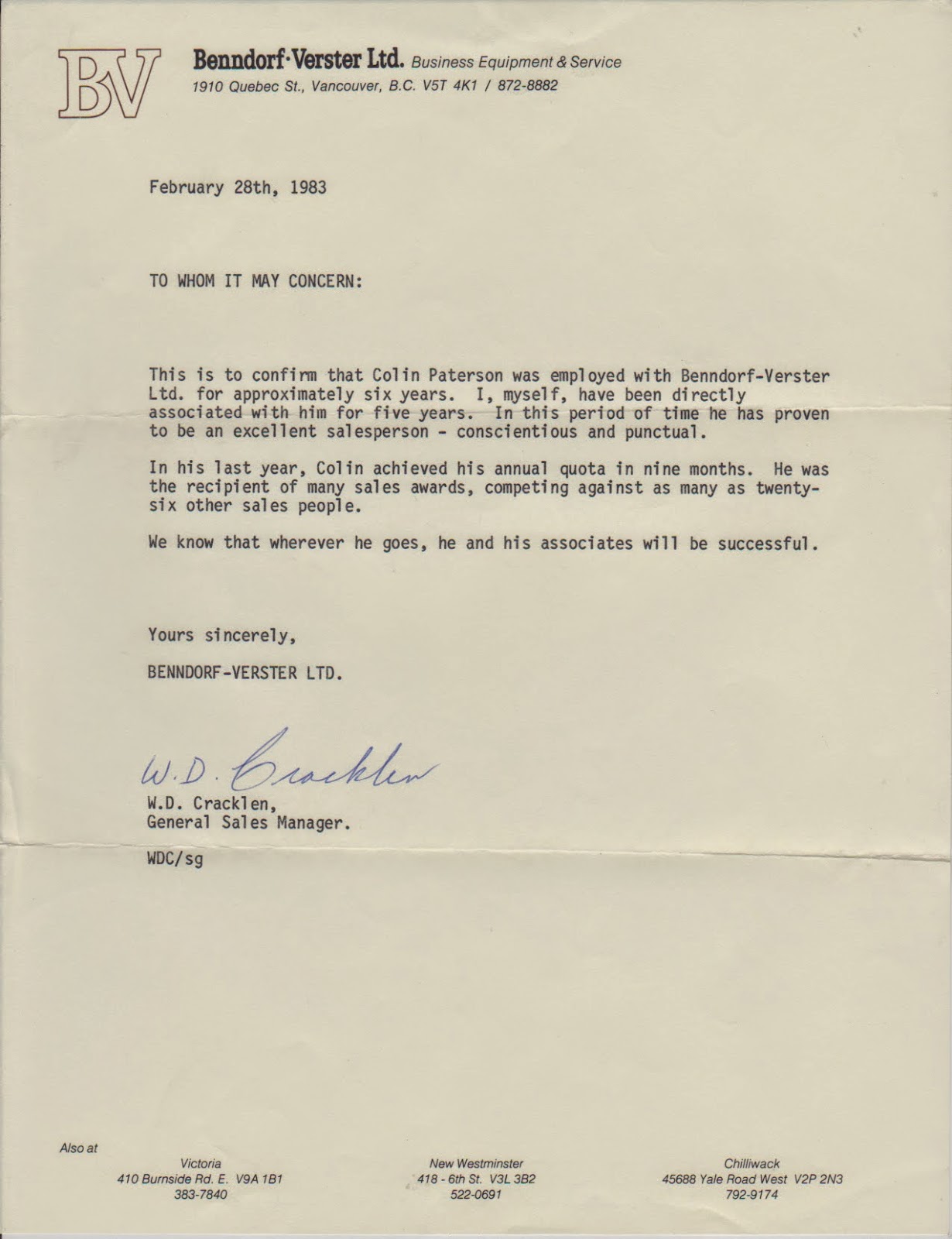
Bill Cracklen, the copier sales manager, was from Winnipeg and had been in the carpet business there with his dad. When I started at BV Bill was one of the copier reps but later quit to work directly for Canon in Alberta. When BV was in need of a new copier sales manager Bill was asked to rejoin the company. It was probably the best decision he ever made in his life as he would later become a millionaire for his efforts.
Back then Bill was a heavy set guy who looked a bit like a former middle linebacker in football. He often had a cigar in his mouth. He drove a big cream coloured Lincoln or was it a New Yorker? Bill wasn’t the kind of guy most people would not want to mess with physically and it wasn’t a good idea to get on his bad side.
You might say that Bill was a no nonsense kind of guy when it came to sales. When I first knew him he was a kick some asses and take numbers type of person. If the sales volume wasn’t where he wanted them to be he could go into a rant at a sales meeting leaving some a bit terrified. He wasn’t someone you challenged if you wanted to keep your job. As time went by Bill mellowed a bit having probably figured out that it wasn’t a good idea to scare the shit out of your sales staff.
Over the ensuing years I became friends with Bill. We were never best buddies or anything like that but there was a mutual respect. He liked producers and I became one. I also outlasted most of the other reps so I was an ongoing familiar face.
I went to a number of amateur boxing matches with Bill back then out at an old arena on the Pacific National Exhibition grounds. The place looked like a barn. The fights were called “So you think you’re tough?” The whole deal was a bit hokey and the crowds were a mix of business types and some who looked like they had criminal pasts. Two of the boxers we saw later had pro careers. There was a black guy named Jerry Reddick (AKA Mack Truck) who fought in a lighter weight division. After he had won his fights he would always do a standing somersault. Another tough guy who was a heavyweight was Gord Racette who was from Nanaimo. He had a pro record of 39W and 6L. He once fought for the Canadian heavyweight championship.
I think I was the first person at BV who Bill told that he was separating from his wife. He got involved with a gal at the office and they have now been married for over 35 years I think. We went to his wedding at The Bayshore Hotel. I remember one particular conversation I had with Bill in my car. I asked him what the big deal was in life in trying to make whole a lot of money. He shook his head in bewilderment and told me to go and have relations with myself.
Bill and Claudette and Evan Peletz at our place on Bowen Island.
Bill retired from the company in 1995 about 12 years after I left the company. I was honoured to be one of the few old timers he asked to attend his retirement party. Bill and his wife Claudette now spend parts of the year at their homes on Lake Champlain in Quebec and in Florida. Golf was always Bill’s passion away from work and I’m sure he has got a lot of rounds in since he retired.
So here I was in 1979 with my big chance to sell something that I could actually make some money on. The copier I had to sell was called a Canon NP50. It sold for about 4 grand and my commission would be just under 500 dollars. The NP50 had a number of limitations including a very slow operating speed, it could only copy onto letter and legal sized paper, had a moving top, and it used a liquid toner which meant copies could only be made on a hard surfaced paper.
The territory I was given was part of the downtown Vancouver area. Over my first several months I managed to place about 20 Canon copiers. I was on my way. I shared the area with a guy named Don Beach who marketed the rest of the Canon line. Don was to become a big influence in how I approached sales.
Don Beach was about 4 years older than me. At the time, he had been with the company for about 10 years other than a year's absence when he worked somewhere else. Don was a seasoned veteran when I first met him. He was one of the best sales people I have ever met. More than anything else I learned how to use logic from Don.
I believe that there is a price for almost everything in life. I realized quite quickly that Don was always about Don but there wasn’t a better guy to learn from. I was pretty tenacious at cold calling and would run into situations where I didn’t have a suitable product to fill the customer’s needs and I would pass the lead on to Don. I would like to say that my efforts were reciprocated but they weren’t. I remember one deal that I got Don in on where he made about $1400.00. My reward  from Don was an 8 dollar bottle of rye.
 
Don on I both lived on the North Shore and he invited me to join him a number of times at the racquet club he belonged to. He wasn’t the kind of guy who hung out with his co-workers away from work. I remember Don once saying that the reason he quit smoking was because one morning while he was shaving he looked in the mirror and saw his cigarette sticking out of the saving cream.
Back then Xerox was the big player in photocopiers. The Xerox name was so powerful that it was a synonym for a photocopier. There was nothing finer than kicking some Xerox college grad's ass back then and Don got a hold of some Xerox contracts from his clients and started deciphering the small print. Some of the agreements were quite complicated but Don figured it all out. For the most part Xerox only rented their copiers on two year plans with a 30 day window at the completion of the contract to cancel.
Don was always a low key kind of guy. Customers often found it almost soothing to talk to him. Don knew exactly what he was doing. He wasn’t a by the seat of his pants kind of person. He had a way of making things seem logical to his clients and didn’t bother with wild claims or bombast. Don always knew how to reel them in.
Most of Don’s advice was right on the money but there was a time I was very glad that I didn’t listen to him. One day he asked me to come into the copier show room for a private conversation. The BC provincial government had just given 5 shares to every adult in the province in a government owned entity called BRICK (The BC Resources Investment  Corp). Don suggested that I take every dime I had and invest it in BRICK. This was going to be a big winner he thought. Within a few years those shares became totally worthless.
For some reason most of the technicians at Benndorf-Verster were East Indians. During the time I was at BV there were only a few East Indian sales people. One of them later committed suicide. The go to guy for technical problems on copiers back then was a Czech born guy named George Vytasek. 
Al Reilly, lower right, and service staff.
Around 1979 or 1980 things began changing more rapidly at BV. A white board was put up on the wall in the back of the sales office that showed each reps sales for the month. A bell was attached to the wall by the white board that sales people could ring when they got a sale. Most of us thought it was tacky but one guy really enjoyed ringing that damned thing. The company seemed to be hiring younger copier reps including some women. A few ex Xerox people also joined the sales staff.
It got to a point where the company was running out of room and the copier sales team moved across the street and a little later to a building about a block way.
One day we came to work to find stuffed monkeys on our desks. The company had several copiers called an L7 that nobody could get rid of and I guess the premise of the monkeys was to get them off our backs and off our desks if we sold an L7. It didn’t work. There were a few times that those monkeys were put into a variety of sexual positions by some of the sales staff.
BV from time to time would invest in sales motivation. One course ran the best part of a week and covered a lot of closing techniques. It was run by a pair of ex Xerox guys. We also attended a 2 day thing down at the Bayshore Hotel. Throughout those 2 days there were about a dozen people who each spent about an hour on stage describing how they had become successful in sales. The one I remember the most was a guy who sold insurance in Florida. He lived in a rural farming area and was wondering what he needed to do to make more money. He figured out that farmers were out on their tractors at about 5 a.m. in the morning and he started to drive out to the farms and find them. He would jump on to the tractor with an extra coffee in hand and have a captive audience for as long as he needed.
While I was sitting there watching the motivators I started doing some math. 300 bucks a pop for each attendee times the number of attendees which was about 600 equals 180 thousand dollars in revenue. After overhead these motivators were making something like $5,000.00-$10,000.00 each for an hours work. Beats the hell out of sales I thought.
Up until about 1980 the Canon line of copiers was nothing that special. None of their copiers had document feeders like Xerox had or BV’s other big competitor at the time Copytron. There was an attempt to add an “L” shaped piece of plastic so that users could leave the copier lid up. It was pretty hokey. A $10.00 piece of plastic to make a $10.000.00 to $15,000.00 machine more functional seemed kind of lame.   Then a feeder from an outside source was brought in but it was crap. BV had the Canon NP5000 that sold for about 10 grand and the NP5500 that had 2 reduction modes and sold for about 15 grand. A 20 bin sorter could be added for another 5 grand. I remember almost dancing on air once when a customer bought an NP5500 and a sorter for 20 grand. I made almost 3 grand on that deal.
I think it was around 1980 that Canon introduced 2 new models which really put BV on the map in copier sales in Vancouver. One was called an NP200 which sold for about $4500.00. It could copy up to 11” x 17”. It had a sheet by-pass, was easy to use, was bright red in colour, and most importantly could copy onto any kind of paper unlike the Canon NP50. The other machine was called a Canon NP80. It sold for about $7300.00. It had a copy speed of 32 per minute and a fast first copy speed of 6.2 seconds. The one drawback was that it used a liquid toner and could only copy onto a hard surfaced paper.
Up until then liquid toner copiers were thought to be messy. This was found not to be the case with the NP80. Aside from the fast speed of the NP80 there were a couple of other positives. It was really inexpensive to run and it was great at copying photographs and half tones. I became rather slick in demoing the copier. I went down to a second hand bookstore in Vancouver and looked for the perfect air brushed kind of photo and found one in and old magazine. It was a black and white photo of a Volkswagen. I would also take off my watch and put it on the glass of the copier and show people the second hand moving from one copy to the next. It was a bit of showmanship but it made me a lot of money.
 
At the time one of our reps was a feisty little blonde gal from Saskatchewan whose name was Elaine White. I remember Elaine telling us of how she had grown up in an abusive family and sometimes had to resort to eating dinner out of a can. One day Elaine came back to the office with what may have been the biggest order for copiers at BV up until that time. She sold a whole slew of NP80s to the North Vancouver School Board.
Some of sales staff and a few of the technicians starting meeting on Friday nights at about 4 p.m. for a few brews at a nearby waterfront pub called Stamps Landing that later became known as Monk McQueen’s. Management got wind of people cutting out from work early on Fridays and it was a short lived tradition. Apparently Bill Cracken let it be known that he would make a surprise visit to the pub and anyone found on the premises during working hours would be fired on the spot.
 
My sales production really took off and I became one of the leading producers for the company. Never once did I think I didn’t deserve my success. I worked hard and made a lot of cold calls. I didn’t brag or pretend I was anything special. There were a few around who weren’t fussy about my success and as far as I was concerned they could go and screw themselves. You know you are doing something right when other sales people ask you for advice or want to bring you along on a call.

 
My guess is that some that I worked with back then might have considered me to be a bit of a loner. I was in some ways. First of all my lifestyle was different than most of the others in that many of them were married and I wasn’t. I never liked cliques or office politics. To me small talk has its limits and sucking up to people has never been my style. Once in a while I would grab a beer with a co-worker and I remember a guy named Barry that I played tennis with several times. I had a life away from the job, a life that included going out of town often on weekends and chasing women in Vancouver’s discos.
The next product Canon introduced was a NP6300 which was their first copier with a document feeder. Unfortunately the feeder had a number of jamming problems. I can’t remember how it all came about but 2 sales managers were hired to work under Bill Cracklen who became the general sales manager. The sales reps were broken into 2 teams. There was going to be 2 sales reps in each territory, one to sell the lower end copiers, and one to sell the higher end equipment.
I can’t say that I was particularly fond of any of the sales managers I had. They needed me a lot more than I needed them. I didn’t need to bring them along to close a deal. I remember one manager who would tap on his window and motion with his finger for me to come to his office. I just ignored him. Later I told him to get off his ass if he wanted to see me or call me on the phone. I wasn’t going to be his pet dog.
Another manager who I wasn’t impressed with had grammar problems and would say “Youse guys.” I could overlook that but he really pissed me off when I took him along on a big deal I was working on and he took it upon himself to tell the buyer that my quote didn’t include pricing on messy liquid toner copiers when in fact my quotation did. What a moron! I had to do some dancing on that deal and vowed that I would never again bring this idiot anywhere with me again.
Benndorf-Verster was big on contests. One of more memorable ones was a deal where teams would compete for a free trip to Las Vegas. Each team was made up of technicians and sales people. There were 2 teams and the deciding factor of who would get the trips would be based upon who could come up with the funniest ribbing of the sales managers. I volunteered to write the jokes for my team.
The other guy used joke books for his script and I used my imagination. I can’t recall how the voting worked but my team lost by a small margin. So much for creativity I thought. One of the sales reps that went on the Vegas trip got drunk and ended up marrying someone he had just met. It took him some time to have the marriage annulled.
The having 2 sales reps in each territory had its drawbacks. I thought it was a stupid idea from the outset. I remember sharing the Richmond territory with a lady rep. I got tired of giving her leads and getting none in return and started selling used equipment instead of giving her freebees. One day she stormed into Bill Cracklen’s office and started raving. I was called in to listen to her rant. I had already told Bill that I thought she was unstable. After she stormed out of Bill’s office I said “I rest my case Bill!”
I shared another territory with an older rep. He had given me a list of about 15 accounts I couldn’t call on but got upset when I found sales in other areas claiming that he had already called on them. I can’t say I wasn’t amused about his frustration.
One day I had a chat with the vice president of the company, Al Hausch. It told him I thought it was idiotic to have sales people fighting with each other. Al told me he would run the company the way he saw fit and I told him he would do it without me. I quit.
I got a job with a company called Micom marketing word processors. It gave me a headache trying to figure out how those damned things worked. Mnemonics wasn’t my forte. About 4 months after I quit BV I was asked to rejoin the company. They had decided to scrub the 2 salespeople per territory thing. I jumped at the offer. After I left Micom I got a letter from a parking garage where Micom had parking space for its employees telling me I owed money to the garage for not giving them notice that I no longer needed the parking spot. I put the letter in the round file.
In late 1980 I got involved with one of my fellow employees, a gal named Theresa. At the time Theresa was a customer service rep. We once got thrown out of a bar at the Point Grey Golf & Country Club, where I had a copier on trial that was later sold, when we were told that it was a men only bar. Theresa’s background included being a stewardess for Wardair before joining BV. She was a rep for a while with BV but had a bit of a tough time of it. She once fell down a flight of stairs. Theresa later went on to have a great career marketing ceramic tile and has probably been to Italy over 15 times on buying trips over the last number of years.
 
Theresa and I got together through jogging, something I never had a passion for. In late 1980 we were living together and in May of 1981 we bought a waterfront house on Bowen Island. Theresa was from Gull Lake, Saskatchewan and we were married there on the same weekend in August that Chuck and Di tied the knot at the beginning of August 1981. Elaine White from BV came to the wedding. Theresa and I had 2 kids together, twins, a boy and a girl. We split up in 1995 after 14 years of being married.

For a while before I really knew Theresa she drove one of the Benndorf-Verster blue with white lettering Hondas. One weekend on the way back from Whistler with a gal friend, they spotted Vancouver Canuck hockey defenceman Harold Snepts driving in front of them. They both knew Harold. Theresa’s passenger decided to moon him.. Apparently a few others had witnessed the moon too and there was a call or two to BV’s office on Monday.
BV cars.
In December of 1981 I had my best month ever in sales, something like 130 grand. I think my commission for the month was close to 20 grand. To celebrate my good fortune I took my sales manager and Bill Cracklen and their better halves along with Theresa out to dinner at a place called The Mansion. I was riding pretty high at the time.
I remember when the company decided to have someone look after “major accounts” and Don Beach was chosen to look after that responsibility. Don was allowed to pick a number of larger business or government entities from sales people’s territories. I had recently got in at The Workers Compensation Board with the sale of copier and Don plucked that account from me. I had a smile on my face when Don later found out that my contact had been fired for taking a bribe from someone and Don had s to start all over with the account.
Each year BV would have a deal where whoever had the most sales for the company would be rewarded a small trophy of a man carrying a briefcase and that person would also attend a dinner with some other companies at a fancy hotel. I’m not sure if it was 1981 or 1982 but I was leading the pack into the last month of the fiscal year. It wasn’t a contest I really paid any attention to. In the final month Don Beach passed me in sales and I never gave it much thought until another rep named Bob Salway pulled me aside and told me the trophy should have been mine because Don worked in major accounts and his profits for the company weren’t as good as mine because he could sell at a discount. If Don wanted the trophy that much he could have it I thought and I never disputed his win.
So here I was in early 1982. I was happily married. We were living in a waterfront house on Bowen Island. My sales figures were still very good. Life couldn’t have been better. It was around March when I decided to take a vacation in Hawaii. My parents-in-law had a condo close to the beach at Waikiki. I was going to spend the first week with Theresa’s parents and Theresa was going to join us for the second week. One day in the first week I decided to go jogging along a nearby canal. It was hotter than hell out and I didn’t do any stretching before I started my run.
When I got back to the condo after the run I felt a bit stiff but thought it would just go away. Theresa had just arrived and we had plans to go out with people we knew that night for dinner. I jumped into the back seat of a cab and my back went “click”. Something was wrong but I didn’t know exactly what it was.
When we got back to Vancouver my back got worse. I had a hard time climbing stairs. I saw a doctor and he suggested a long period of back rest and showed me some exercises for my back. I was going to have to quit working. When I told my sales manager that I would be quitting he told me that I wouldn’t be able to collect on a trip I had won because I wouldn’t be with the company any more. He never showed any empathy for me at all and it was obvious that he was disturbed because he was going to be losing his top producer. What a little prick he was I thought. I went to the VP Al Hausch and he had a cheque cut for me for $3500.00 which was the right thing to do and I appreciated it.
 
I didn’t work for about 6 months. I was in the hospital for the best part of one of those months and taking Demerol. I didn’t know if I was punched or bored. Finally an operation was performed which turned out OK and I had rebuild the muscle tissue I had lost. Instead of going right back to BV I took a job in sales with a printing company that was owned by a guy I knew. This guy’s company was a mess and he was clearly in over his head. On top of that he found out that his bookkeeper had been embezzling from him. And then his wife left him.

I went back to work at BV. This time things were different. There were a lot of new faces and there were now other guys who were the big producers. About half of the sales staff were people I had never met before. The territory I was given had been pretty well worked over by the previous salesman who had it and was in a crappier part of town. He had a record of almost every business in the area. I kind of lost a bit of my zest for the whole deal. I was tired of the same old same old same old. One day I walked into the office and quit for good.
 
In the back of my mind, for some reason, I wanted to get into sales management. I knew this was never going to happen at BV because I was probably thought to be a bit out there when it came to conformity. Rolling a joint at my desk one day probably didn’t get me any points.
I hung around the industry for a few more years and did become a sales manager. The owner of that company was a twit and that whole adventure was a fiasco. In 1986 I started my own company marketing copy paper. I had sold a copier to Costco before they opened their first store in Canada in Burnaby, BC and started buying copy paper from them. I could jam about 12 cases into my Celica GT sports car. I would make about 250 bucks a trip. I started keeping the copy paper in a storage locker and then a bigger storage locker. The volume continued to increase and it got to a point where I was buying about 15 tons of paper a month from a paper supplier. I moved the office from our apartment to an office on the Vancouver East Side and later to a spiffy office overlooking the Fraser River. I hired a few staff and added on products like laser and fax toners.
 
The business grew and grew. Like a lot of other small businesses it was really hard to find a decent sales rep. The only one that ever was productive went back to the copier business. I was doing almost everything  myself except answering the phone, bookkeeping, and deliveries. In 1995 I split up with Theresa and my secretary (Rhonda) found a large house to rent where I could cut my cost by running my business out of it. Later on I found another house with a pool. About 10 years ago I sold my accounts to a competitor and semi-retired to Vancouver Island. I kept the business name. The company has now been in existence for over 28 years. I still dabble a bit with the business and it only takes a few days out of the month in the time I have to spend on it. I have about 300 customers on Vancouver Island. All the products are dropped shipped from Vancouver. Most of my clients are restaurants and bars and I don’t market the same stuff I used to.

There is a lot of water under the bridge since those Benndorf-Verster days. After I left, the company got into financial difficulty. BV had 5 divisions and only one, the copier division, was making money. Along the way a large debt to Canon had built up and they wanted BV to have new management instead of seeing the company have to close its doors. Bill Cracklen  and 2 others were chosen to take over the reigns of the company and Guy Verster and Al Hausch were removed from their positions. BV's fortunes were turned around under the stewardship of Bill Cracklen. 4 years later the company was sold to an American outfit called Alco. Bill stayed on for several years as company president and took on the additional responsibility of acquiring other independent companies for Alco before retiring in 1995.

In 1999 Don Beach sued Ikon Office Solutions, which is what Benndorf-Verster evolved into, for wrongful dismissal.. One day in 1998 Don was told that his services were no longer required.  Don was making something like 350 grand a year at the time. It wasn't the only dismissal from BV that ended up in a court suit. There is nothing like a good court suit to see former co-employees turn on one another. Don won his case. Later Don resurrected the Benndorf-Verster name and with another copier brand attempted to compete with the company he had spent most of his working career with. Don was now past 55 years in age and starting over. Vendettas often don't work out well and the name Benndorf-Verster didn't have the clout it once had. It would be interesting to see what Don has chosen to do in his retirement.

There is scenario in business that seems to occur quite often when a company owner reaches a certain age. Sometimes a son or daughter is groomed to take over but they often aren't as capable or competitive to be able to keep steady cash coming in. Businesses have cycles and the competition and marketplace evolves over time. There are times when the best bet is to unload the company, often to an American corporation, while the value is high and before the profits start to shrink. The owner doesn't want to hang around and fight for survival into his 60s. There are a lot of things he can do with several million dollars in retirement.
One of the things that has burned my ass a bit over the years is reading about sales managers taking credit for sales volumes. Sales managers don’t produce sales, sales reps do and when they are really good at their jobs it is because of their own talents.
Selling copiers is something that gets stale after a while. Most of the really productive sales people only last a few years before moving on to something else where they have more control. Many of the people I worked with in sales at BV started their own businesses and cut out the middlemen. Some went into real estate and others went into things like teaching.
One thing that is for sure is that there are a lot of fragile egos in a room full of sales people. Personally I always preferred the types that had a bit of humility and didn’t think they were the next best thing since sliced bread. Jealousy is something that doesn’t look good on anyone. And bullshit is always bullshit no matter how you wrap it up.
I guess what I remember most about being at Benndorf-Verster is being young and full of vigor. I remember once having a customer who needed to see 3 different vendors before making a decision. I went with him to the 2 other vendors not letting on who I was to them. Our 3rd stop was to a place called Copytron. After the demo, the sales manager brought us into his office to close the deal. One of his salesmen recognized me and phoned the sales manager to tell him who I was. The sales manager wouldn’t answer his phone because he didn’t want to be distracted in trying to close the deal. I remember the guy I knew and the sales manager staring down at us as in the stairwell as the customer and I left the building. I got that deal.
I remember the sales gals like Helene Levasseur and Elaine White who could give the guys a run for their money. I remember Lanny Flores helping us move to Bowen Island. I remember an ex Xerox guy named Norm Bolitho telling us that after he left BV he was hired by Trinity Western University as their soccer coach probably because he had the same last name as a Vancouver Whitecaps player and being canned later when they discovered that Norm wasn’t particularly religious. I remember Doug Benton getting in over his head in a colour copy business he started. I remember running into James Long after he left BV when he was in the business of marketing aerodynamic skirts for tractor trailers. I remember counting my fingers each time I shook hands with Jack Stephanian when I would run into him somewhere. I wonder whatever became of Wilf Moss?
 
Doug Benton's birthday present?
More than anything, what I learned in my time at Benndorf-Verster was to believe in myself and my own capabilities.  I was never going to be big time running my own business but it paid the bills and then some for many years. Many of those who I worked with back then are now retired or close to it. Here’s hoping it all worked out for the best for all of them and that they are enjoying their retirement.

........................................................................................................................................................................

After writing this story I sent an e-mail to Bill Cracken and we talked back and forth about the old days at BV. Bill straightened me out a bit on the behind the scenes activities and how he ended up running the company and I edited my story on BV a wee bit. Yesterday (June 9th) he called me from his summer home on Lake Champlain in Quebec and we chatted for a little less than an hour. It was great to talk to him and listen to his insights. Bill and Claudette are both enjoying their retirement.

Update: Had coffee and an early dinner with Don Beach in mid March in Parksville He was visiting his sister in Qualicum Beach.. Don is recovering from a recent bout with cancer. We swapped a few yarns about the old days and talked about life. Don drove back to Vancouver in his flashy new Mercedes.

2nd Update: Don Beach passed away on May 28th, 2016. Another long time BV sales rep, John House, who had been in WW2, passed away about 8 months ago at Qualicum Beach on Vancouver Island.